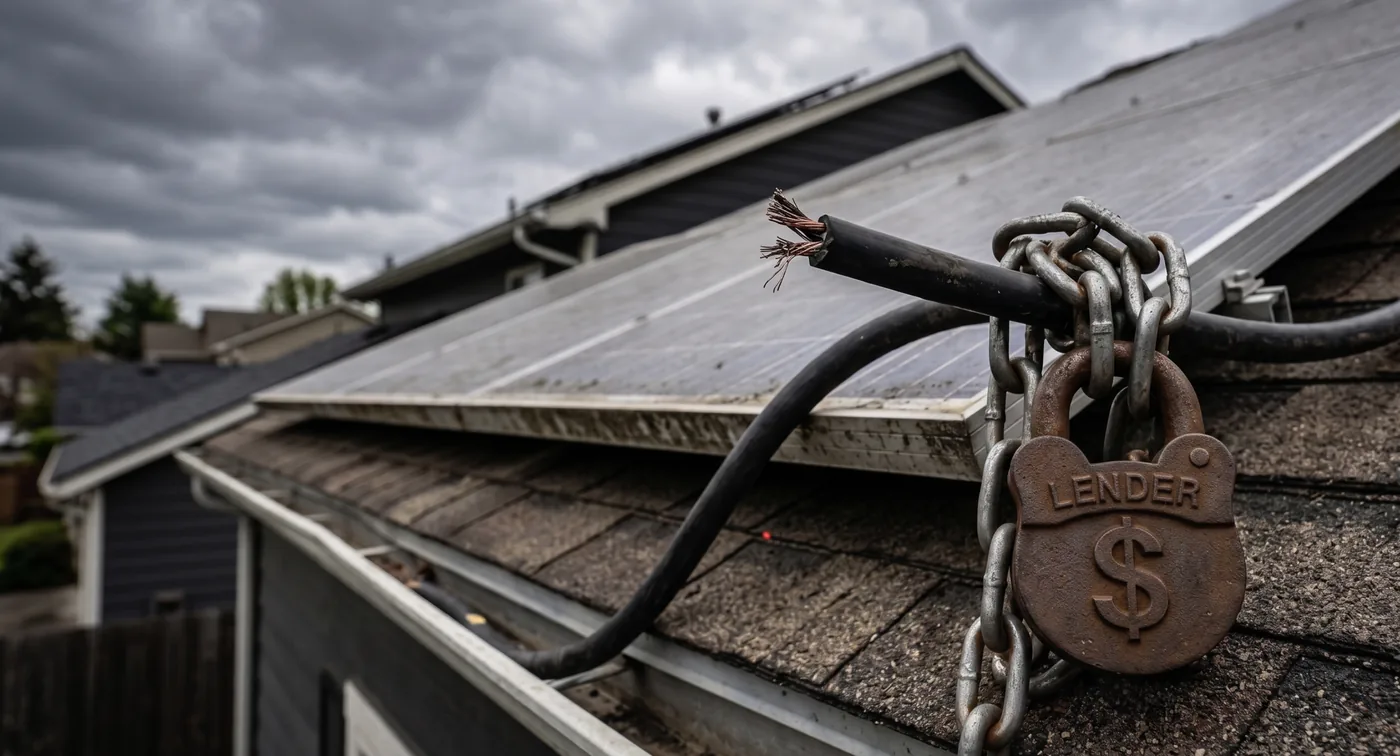
When an installer closes, stops responding, or leaves work incomplete, it can be difficult to know which company is responsible for each part of a solar project. The installer, financing company, equipment manufacturer, and account servicer may be different businesses. The signed agreements and account records can help clarify those roles.
$170,000+ recovery
Against Sunlight Financial · Solar fraud arbitration
- $113,000 loan cancelled
- UCC lien removed
- Credit repaired
- $58,000 cash to client
Past results do not guarantee a similar outcome. Every case is different.
This guide explains what the FTC Holder Rule may cover, which records to gather, and why an installer’s closure does not by itself determine the status of a separate financing agreement. It is general information, not advice about a particular contract or payment decision.
Free consultation
Solar panel contract problems?
We review accepted solar financing with any installer. Free case evaluation.
Start with the documents and company names
Compare the sales and installation agreement, financing agreement, completion or acceptance documents, account statements, and any transfer or servicing notices. Note the exact legal names, dates, account numbers, and what each document says about installation, payment, servicing, and dispute procedures. Keep copies of messages, photographs, inspection records, and notices about unfinished work or system performance.
A business relationship between an installer and a financing company may be relevant in a particular dispute, but it does not by itself establish that the financing company is responsible for an installer’s conduct. The contract, transaction, and applicable law matter.
If you are trying to identify a company named in your paperwork, our solar installer directory includes summaries of dated public records for Titan Solar Power, Pink Energy / Power Home Solar, and Lumio. These records may help distinguish company names; they do not show who owns or services an individual account or determine the merits of an individual dispute.
Bennett Legal is not affiliated with Titan Solar Power, Pink Energy / Power Home Solar or Lumio.
What the FTC Holder Rule says—and what it does not
The FTC Holder Rule applies to certain consumer credit contracts used to finance goods or services. When a contract is covered and includes the required notice, the Rule preserves a consumer’s ability to assert claims and defenses against a holder that could be asserted against the seller. The FTC describes seller misconduct such as misrepresentation or breach of contract as examples. See the FTC’s Holder Rule overview and its 2022 advisory opinion.
The Rule does not decide whether a seller breached an agreement, make a financing company liable in every transaction, or automatically cancel or change a loan. Coverage and available claims depend on the contract, transaction, facts, and applicable law. It is not a reason to stop, delay, or redirect payments without advice about your specific agreement.
A practical records checklist
- Identify each agreement. Separate the installation or sales contract from a loan, retail installment contract, lease, or power purchase agreement. Record the legal names of the seller, creditor, current account servicer, and any company that sent a transfer notice.
- Preserve what happened. Save the proposal, signed documents, change orders, completion or inspection records, utility notices, photographs, account history, and communications with the installer and financing company.
- Check the current account information. Compare recent statements with prior notices to identify the current creditor or servicer and any dispute process stated in the agreement. Keep a dated record of calls and written responses.
- Get advice before changing payments or responding to collection activity. The effect of a dispute depends on the agreement and facts. A lawyer can review those documents and discuss available options; this article does not recommend withholding or stopping payments.
For a BrightOak PPA inquiry, provide the contract plus documented proof of a filed UCC-1. The filing alone does not determine whether a financing dispute has merit. See our guide to finding a UCC-1 filing.
Financing we review
Bennett Legal reviews qualifying solar financing involving GoodLeap, Sunlight Financial, EverBright, or BrightOak, with any installer. EverBright matters are limited to loans and retail installment contracts (RICs), including EverOwn; EverBright leases and PPAs are excluded. BrightOak PPAs require documented proof of a filed UCC-1. Whether a matter is within scope depends on the documents and facts. Bennett Legal is not affiliated with GoodLeap, Sunlight Financial, EverBright, or BrightOak.
Frequently asked questions
Does the Holder Rule apply to every solar loan?
No. The Rule covers certain consumer credit contracts and requires a notice in covered contracts. Whether it applies to a specific solar financing agreement depends on the transaction and documents. A lawyer can review the agreement and explain how the Rule may relate to any claims or defenses.
Can I stop paying if the installer closed or left work unfinished?
This article cannot determine what you should do about a payment. An installer’s closure does not, by itself, answer what is owed under a separate financing agreement. Before changing payments, get advice based on the agreement, account notices, and facts of the project.
Will raising a dispute change my credit reporting?
Not necessarily. Credit reporting depends on the account, the information furnished, and applicable law. Keep copies of any dispute and response, review your credit reports, and get individual advice if information appears inaccurate.
Does the Holder Rule automatically cover a lease or PPA?
No. The FTC Holder Rule concerns certain consumer credit contracts; it does not automatically apply to every solar lease or PPA. The agreement and transaction need review. Bennett Legal’s accepted financing scope is described above.
What if the lender or servicer does not respond?
Keep a copy of your written communication and any delivery confirmation, note dates of calls, and check the agreement for the stated dispute process. A lack of response does not by itself establish a legal violation or determine the outcome. A lawyer can assess the record and discuss appropriate next steps.
General information
This article provides general information, not legal advice. An attorney-client relationship is not created by reading this page or submitting an inquiry.
Free consultation
Solar panel contract problems?
We review accepted solar financing with any installer. Free case evaluation.