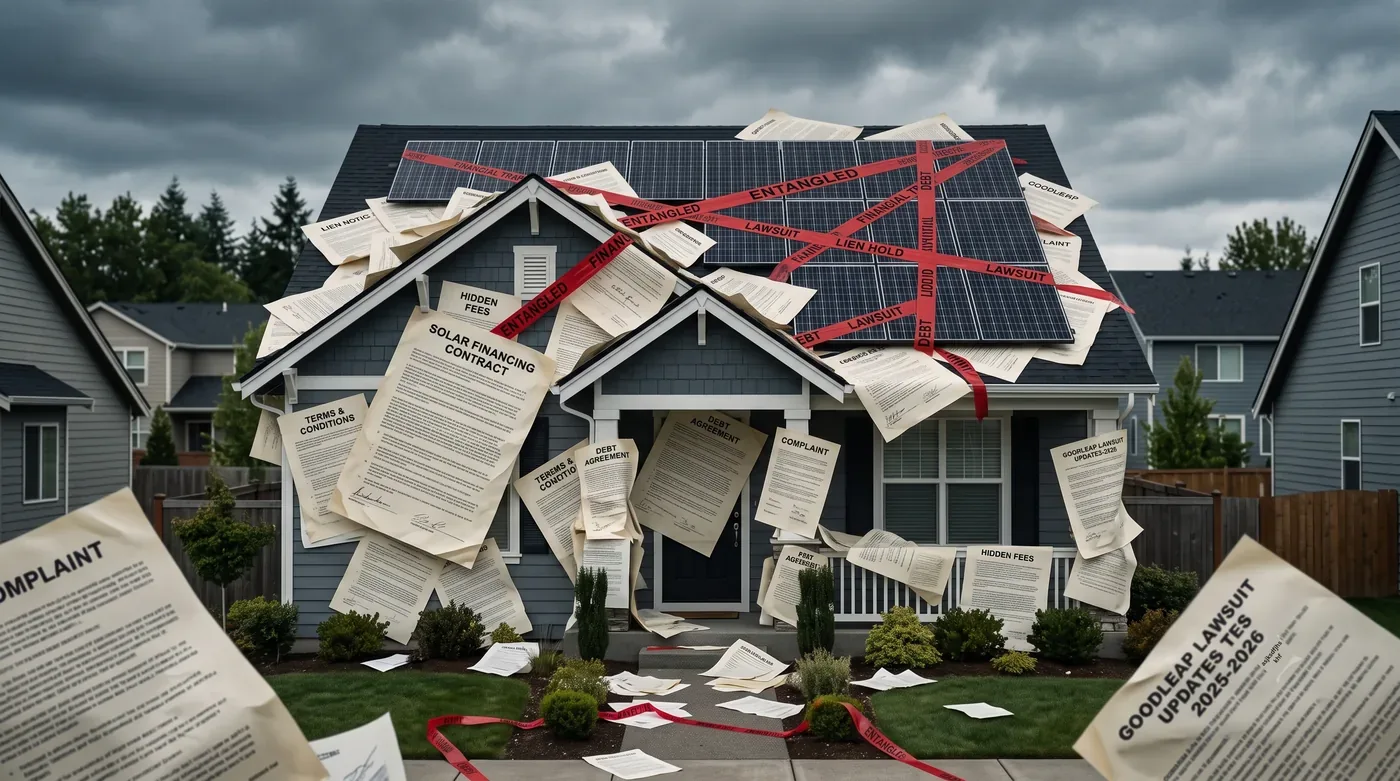
GoodLeap is one of the largest solar‑loan and home‑improvement financing companies in the United States. As solar adoption increases, GoodLeap complaints involving loan terms, payoff amounts, lien releases, and contractor performance have also grown. With new consumer allegations appearing across the BBB, CFPB, and national media in 2025–2026, more homeowners are searching for answers. Bennett Legal reviews GoodLeap loan documents and related records for borrowers facing payoff questions, UCC filing issues, unexpected interest, or contractor-related disputes.
$170,000+ recovery
Against Sunlight Financial · Solar fraud arbitration
- $113,000 loan cancelled
- UCC lien removed
- Credit repaired
- $58,000 cash to client
Past results do not guarantee a similar outcome. Every case is different.
Free consultation
Solar panel contract problems?
We review GoodLeap solar loan disputes. Free case evaluation.
What GoodLeap Is and How Its Solar and Home‑Improvement Loans Work
GoodLeap finances residential solar projects through partnered installers. The company is also known by former names listed on the BBB: Loanpal and Paramount Equity Mortgage. Loans typically include fixed interest terms, long repayment periods, and UCC filings placed on the property. Because contractors originate most applications, inaccurate sales claims or rushed presentations can create long‑term problems for homeowners. The lender‑installer relationship is a major factor in many GoodLeap disputes.
If you're facing problems with a GoodLeap loan — from payoff errors to an unresolved lien — understanding how these loans work is the first step toward protecting your rights. Bennett Legal's GoodLeap practice page explains what we can do to help.
Recent Solar Fraud Recovery: $170,000
Bennett Legal recently recovered $170,000 for a solar fraud victim — $113,000 loan cancelled, the UCC lien removed from the client's property, credit repaired, and $58,000 delivered directly to the client. Solar lenders that rely on the same high‑pressure installer tactics share the same legal exposure. Read the full case →
$113,000 loan cancelled · UCC lien removed · Credit repaired · $58,000 cash to client
Results vary based on the facts of each case, but borrowers facing similar issues should know that significant relief is possible — including loan cancellation, lien removal, credit repair, and monetary recovery.
Current GoodLeap Complaints (2025–2026)
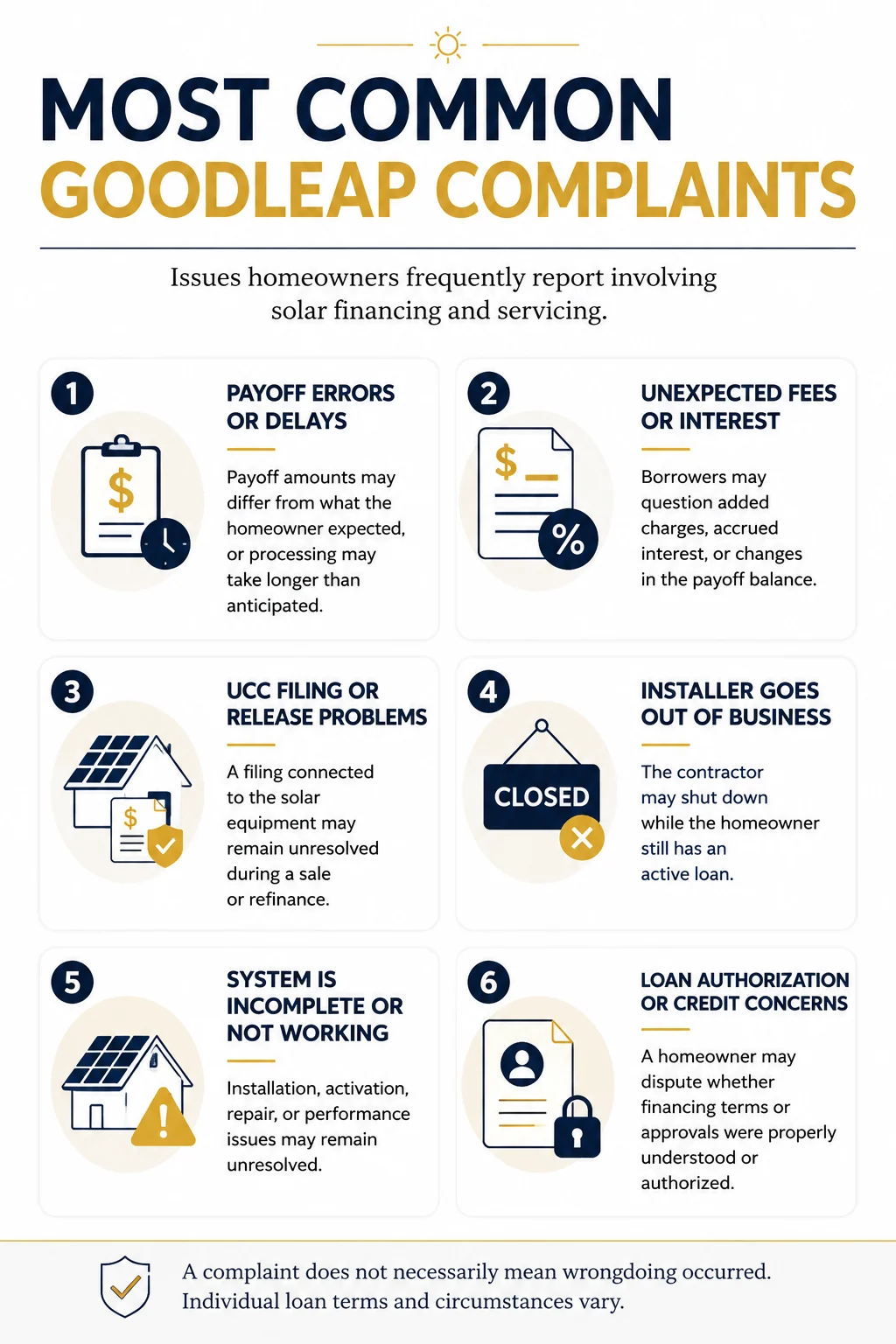
Borrowers report issues such as payoff delays, incorrect payoff amounts, unresolved UCC liens, nonworking solar systems, contractor bankruptcy, loan‑origination confusion, and unexpected fees. These complaints matter because they affect homeowners trying to sell or refinance and homeowners already struggling with solar‑related financial stress.
The volume and consistency of GoodLeap complaints across public databases suggests that many borrowers are encountering the same systemic problems. Understanding the complaint landscape can help affected homeowners recognize that their experience is not isolated.
BBB Complaints About GoodLeap: May–June 2026
Recent BBB complaints show recurring patterns:
- Installer bankruptcy after receiving payment
- Incorrect solar materials or roof damage
- Systems never activated or never producing power
- Payoff quotes differing from final payoff statements
- Capitalized or unexpected interest added to payoff totals
- Lien‑release delays preventing real‑estate closings
These complaint patterns may indicate systemic problems involving loan servicing and contractor oversight. When the same issues appear across dozens of unrelated borrower accounts, they become significant evidence in legal disputes with the lender.
CFPB Complaint Data: What Borrowers Report
CFPB records include complaints tied to Paramount GR Holdings, LLC, which is connected to GoodLeap in state filings. Borrowers report:
- Installment‑loan payoff disputes
- Unexpected fees or interest charges
- Debt‑collection concerns
- Credit‑reporting issues related to solar loans
CFPB data helps borrowers understand whether their experience resembles common, publicly documented issues. Filing a CFPB complaint also creates a formal record that can support subsequent legal claims.
Alleged Loan Fraud and Identity‑Theft Issues
TIME reported allegations involving fraudulent solar loans connected to GoodLeap and Dividend Finance. GoodLeap stated that fewer than 0.05 percent of transactions were fraudulent and reported cases to the FBI. Solar‑loan fraud generally occurs when contractors submit applications without valid authorization. For a full explanation of how solar fraud works and what signs to look for, see Bennett Legal's dedicated article on solar panel financing fraud.
GoodLeap Solar Loan Lawsuit Trends in 2025–2026
Borrowers are raising claims involving:
- Misrepresentation by installers
- Unauthorized loan applications
- Failure to disclose fees
- Contractor abandonment
- UCC lien disputes or incorrect filings
Installer bankruptcy is a major driver of recent GoodLeap lawsuits. When contractors go out of business, borrowers can be left with nonworking systems, property damage, and active loans. Legal challenges usually involve disputes, document reviews, loan verification, and requests for corrections or relief.
Hidden Fees, Accrued Interest, and GoodLeap Payoff Problems
Many homeowners experience payoff letters with unexpected interest amounts, added fees, or processing delays. These issues often arise during home sales or refinancing. Because Bennett Legal is publishing a full article on solar hidden fees, this section remains high‑level: payoff problems may involve accrued vs. capitalized interest, slow processing, or inaccurate loan calculations. If payoff errors cause financial harm, homeowners may have legal recourse.
Read this graphic as text: GoodLeap Payoff Explainer
UCC Filings, Property Liens, and Release Issues
GoodLeap uses UCC filings to secure loan interests. If a lien remains after payoff, the homeowner may be unable to close on a sale or refinance. Borrowers often report difficulty reaching loan representatives for lien termination. Lien‑release delays can create financial and logistical problems, and some homeowners may need to escalate complaints or pursue legal action — see The Hidden Solar Panel Lien That Could Kill Your Home Sale for more on how these liens work.
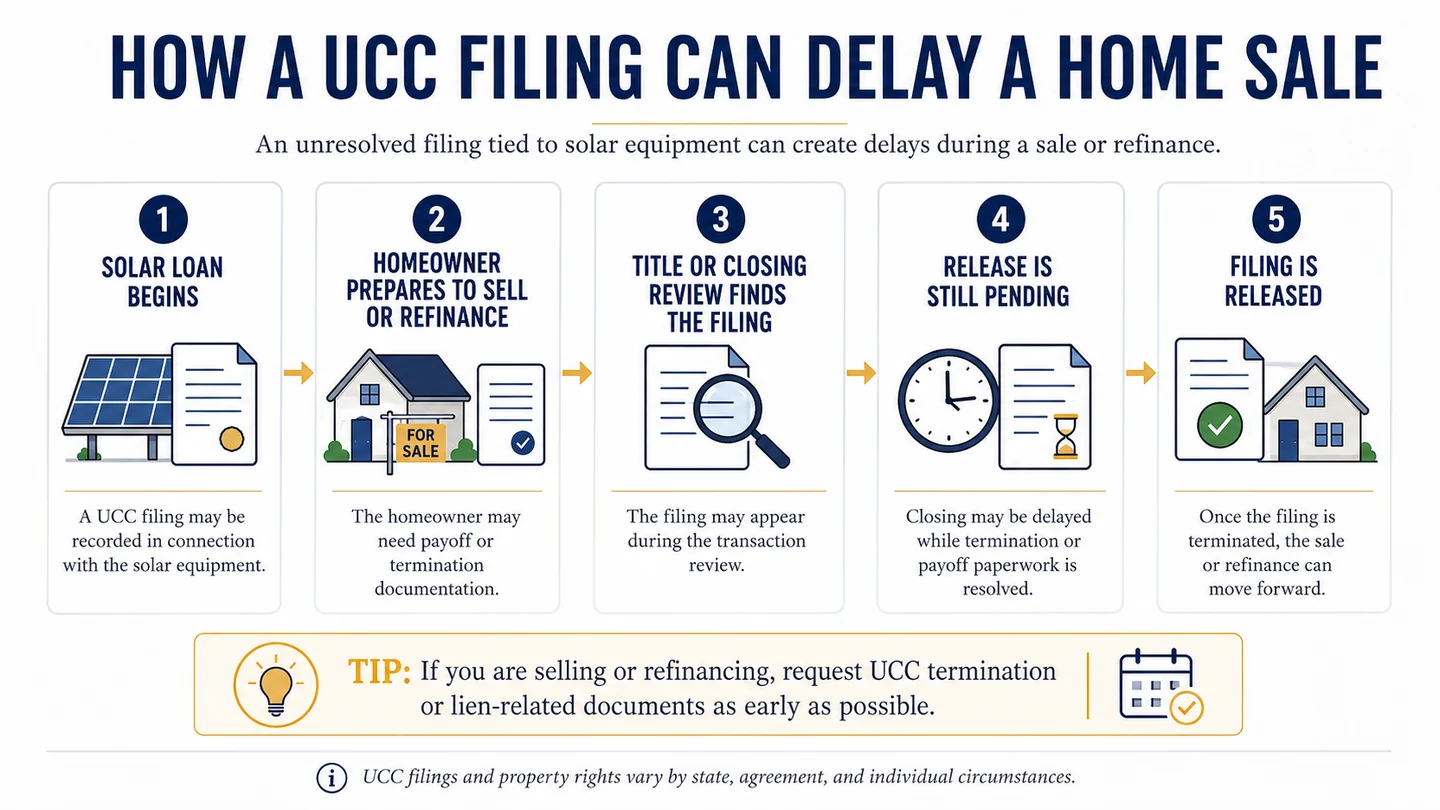
As illustrated in our recent $170,000 solar fraud recovery, lien removal is achievable — but it often requires legal pressure. If GoodLeap has not released your lien after payoff, contact Bennett Legal to discuss your options.
Contractor Bankruptcy, Abandonment, and System Failures
When a GoodLeap‑affiliated installer shuts down, homeowners can face:
- Solar systems that never work
- Incomplete or abandoned installations
- Damage to roofs or electrical components
- PTO delays preventing activation
Read this graphic as text: Solar Installer Shutdown Explainer
These issues appear frequently in BBB complaint narratives and often leave homeowners with monthly loan payments despite system failure. Contractor abandonment doesn't end your obligation to pay under the loan agreement, which is why legal intervention may be necessary to obtain relief.
If you remember the installer but are unsure which company is on your financing paperwork, compare the names on the sales agreement, loan documents and statements with the solar installer directory. It summarizes historical public records and does not identify every lender an installer used; for GoodLeap-specific information, see the GoodLeap financing page. Bennett Legal is not affiliated with GoodLeap.
GoodLeap Solar Loan Cancellation: What Borrowers Should Know
Solar loan cancellation rights depend on contract structure and state law. Some in‑home solicitations include a three‑day cancellation period under the Federal Trade Commission's Cooling‑Off Rule. Long‑term cancellation options vary significantly and often turn on contractor nonperformance, misrepresentation claims, or failure to complete the installation.
Because Bennett Legal's article "How Do I Get Out of My Solar Panel Contract?" covers cancellation rights fully, homeowners should refer to that resource for detailed guidance. In cases involving fraud or material misrepresentation, loan rescission may be available even years after signing.
GoodLeap Lien and Payoff FAQs
Why did GoodLeap place a lien on my property? To secure the lender's interest through a UCC filing.
How do I get GoodLeap to remove a UCC lien? Request a lien termination immediately after payoff; escalate if delayed. If GoodLeap fails to act, legal intervention may be necessary.
Why is my payoff amount higher than expected? Often due to accrued or capitalized interest or added fees. Payoff discrepancies are one of the most common GoodLeap complaints and may be disputable.
Can I dispute GoodLeap solar loan charges? Yes. Borrowers can file written disputes, CFPB complaints, or BBB claims.
What if my contractor went out of business? You may have misrepresentation, breach, or abandonment claims against the lender.
Can I sell my home if GoodLeap hasn't removed the lien? Most lenders require lien termination before closing. This is a time‑sensitive issue — contact an attorney immediately if your closing is approaching.
State‑by‑State Considerations for GoodLeap Loan Disputes
Certain states have stronger consumer‑protection laws governing home‑improvement financing and home‑solicitation cancellations. Texas, where Bennett Legal is based, has specific protections for consumers who entered solar contracts through high‑pressure in‑home sales, and Texas courts have seen increasing solar misrepresentation litigation in recent years.
Borrowers in other states should pay attention to their state's home‑solicitation cancellation rules, consumer‑fraud statutes, and UCC lien‑release requirements. State‑specific protections can significantly affect dispute outcomes and the remedies available to affected homeowners.
How Homeowners Can Protect Themselves
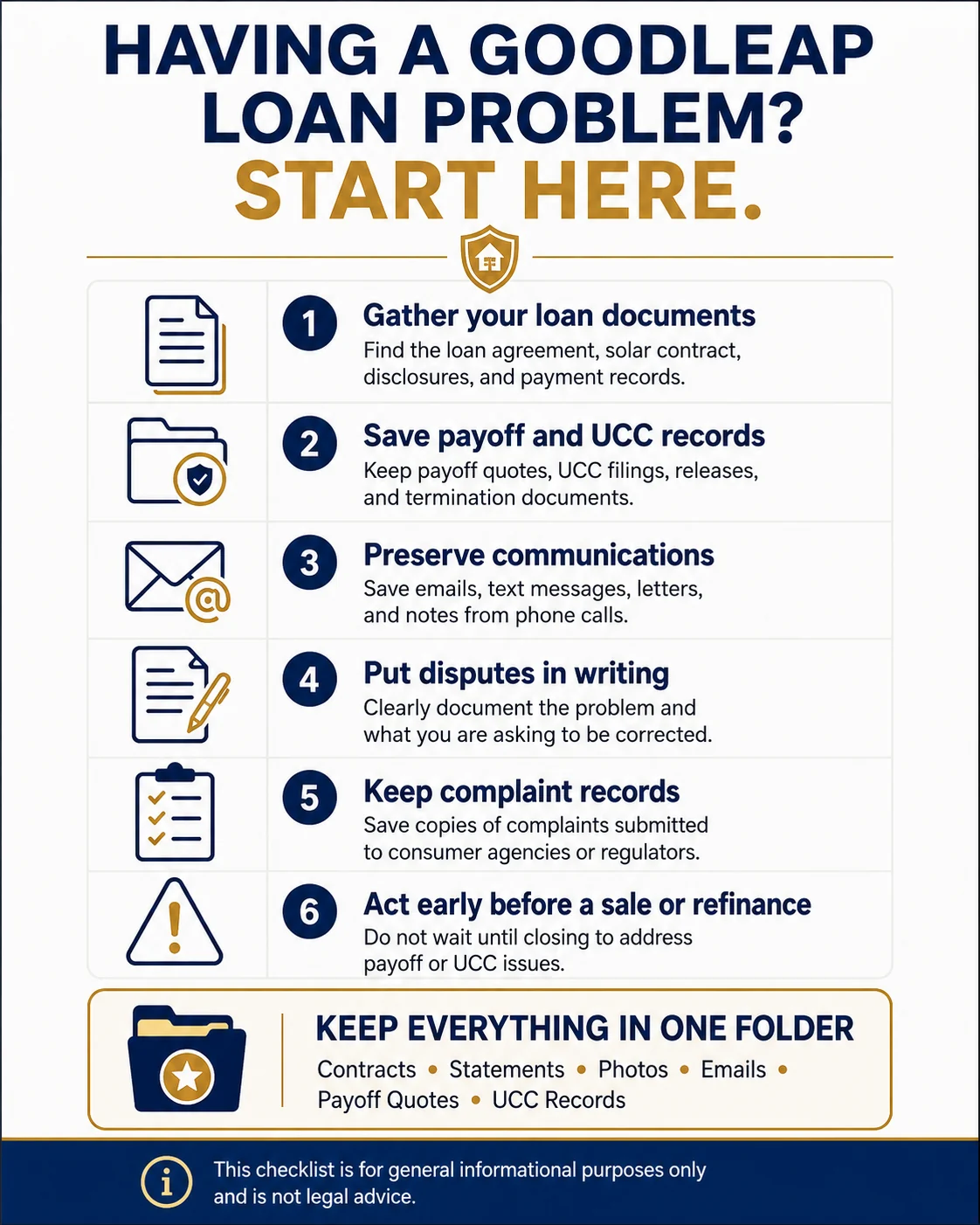
Key steps include:
- Gathering all loan documents, installer communications, and signed contracts
- Saving all payoff statements, lien records, and correspondence with GoodLeap
- Filing disputes with GoodLeap in writing and keeping copies
- Using BBB, CFPB, and state attorney‑general complaint portals to create a public record
- Consulting an attorney early — before a home sale or refinancing deadline forces a rushed resolution
Acting quickly matters. Lien‑release delays and payoff disputes are more difficult to resolve under time pressure. The earlier you seek help, the more options are available.
Considering Legal Help for GoodLeap Loan Problems
Legal intervention may be necessary when payoff errors, lien issues, contractor abandonment, or inaccurate loan terms cause financial damage. Attorneys may pursue outcomes such as lien release, settlement, contract relief, refunds, or credit‑report corrections.
A review of a GoodLeap loan depends on the documents and facts. Keep the complete financing agreement, sales records, payment history and installation records together for individual advice.
Conclusion
GoodLeap loan issues — from payoff disputes to contractor failures — can create serious financial stress for homeowners. If you're dealing with a GoodLeap complaint, a lien that won't release, or a solar system that never worked, you may have more legal options than you realize.
Bennett Legal reviews GoodLeap solar loan disputes. Free case evaluation. Ask about attorney fees and case expenses before deciding whether to move forward.
Free consultation
Solar panel contract problems?
We review GoodLeap solar loan disputes. Free case evaluation.