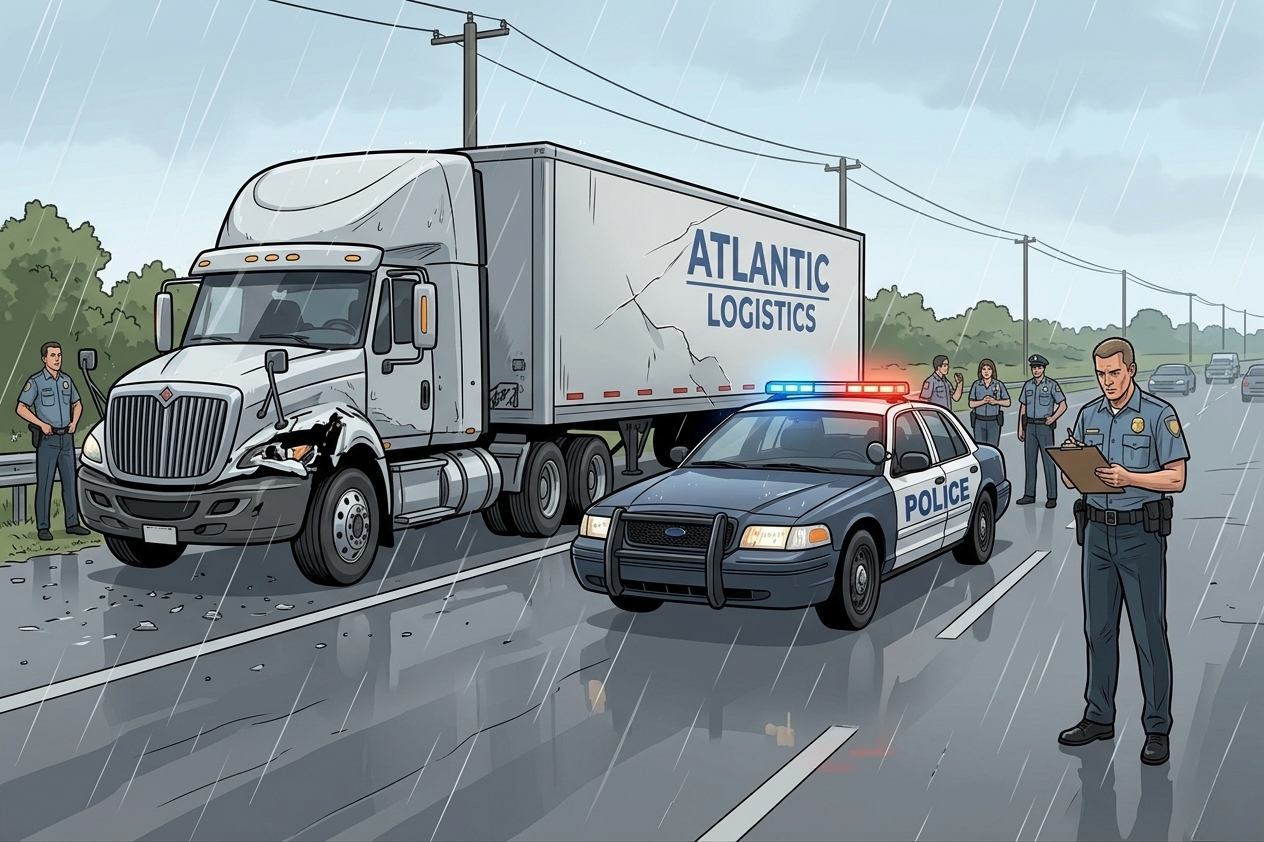
You've just been hit by a commercial truck.
Your car is crunched. Your body hurts. Your mind is spinning.
And right now, you're probably thinking about one thing: What do I do?
If this were just a regular car accident, I'd tell you to call a lawyer before calling your insurance company. That's the smart move.
But a commercial truck accident is different. It's more complicated. There are more parties. There are federal regulations. There are trucking company protocols. And the first few hours matter a lot.
Here's what you need to know.
Table of Contents
- The Big Picture: Reporting Is About Evidence and Deadlines
- Step 1-4: At the Scene — 911, Reports, Truck Info, and Your Mini Report
- Step 5-6: Medical Care and Insurance Notification
- Step 7-8: The Trucking Company's Internal Report and Federal/State Rules
- Step 9-10: Starting Your Claim and Preserving Evidence
- Step 11: Get a Lawyer Involved Early
The Big Picture: Reporting Is About Evidence and Deadlines
When you get hit by a commercial truck, three things happen immediately:
First, the evidence starts disappearing. The truck driver's logbook. The truck's data recorder. The dash cam footage. Eyewitnesses scatter. The scene gets cleaned up.
Second, multiple parties are involved. Not just the driver. The trucking company. The insurance company. Possibly the broker or shipper. Possibly the vehicle manufacturer. Each one is trying to protect themselves.
Third, there are federal regulations that apply. Things like Hours of Service rules, vehicle maintenance requirements, driver qualifications. These regulations create legal duties that regular car accidents don't have.
And reporting—proper reporting—is how you protect yourself against all three.
Free consultation
Hit by a Commercial Truck?
Protect Your Case With Expert Legal Guidance
When you report correctly, you:
- Lock in eyewitnesses' versions of what happened
- Create an official record that's harder for the trucking company to spin
- Trigger the trucking company's legal obligations to preserve evidence
- Establish a timeline that can prove violations of federal safety regulations
- Create documentation that protects you if the trucking company tries to retaliate against you for reporting
Let's go through the 11 steps.
Step 1-4: At the Scene — 911, Reports, Truck Info, and Your Mini Report
Step 1: Call 911 Immediately
Do this first. Before anything else. Do this even if you're hurt. The police report is the foundation of everything that comes later.
When you call 911:
- Tell them there's a commercial truck involved
- Tell them if anyone is injured
- Tell them your location
- Let them ask the questions
The fact that it's a commercial truck matters. It changes how the accident is handled. Police take it more seriously. They'll know to look for the truck's documentation and the driver's logbook.
Step 2: Get the Police Report Number
When police arrive, get their names, badge numbers, and the report number. You need this report number because it's the official record of the accident.
Important: Your police report might not be complete or accurate. But it's the official starting point. We'll work from there.
Step 3: Document Everything About the Truck
Get the following information:
- Truck driver's name, address, phone number, email
- Driver's license number and state
- Trucking company name and address (look on the truck's door or trailer)
- Truck's license plate number
- Truck's VIN (Vehicle Identification Number—on the driver's side of the windshield)
- Truck company's insurance information (should be on the truck or you get it later)
- Trailer number (if it's a semi-truck with a separate trailer)
- What the truck was carrying (this matters—hazmat requires different handling)
If you can take photos, do. Photos of:
- The truck's company name and logo
- The license plate
- The truck's damage
- The accident scene
- Your vehicle's damage
- Any visible road conditions or traffic signals
But don't delay this to get perfect photos. Get the information first. Photos second.
Step 4: Create Your Own Written Record
While you're still at the scene (or in the ambulance, or as soon as you can), write down:
- When the accident happened (date and time)
- Where it happened (intersection, mile marker, street name)
- What happened (in your own words—not a story, just the facts as you remember them)
- Who was involved (other driver, passengers in your car, witnesses)
- How fast both vehicles were going (your estimate)
- What you were doing before impact (driving straight, turning, stopped at light)
- What you felt/heard during and after the impact
- Any injuries you felt immediately (neck pain, back pain, headache, bruising)
- Any conversations with the truck driver (what they said, what they seemed like)
Write this down. Time-stamp it if you can. This is your contemporaneous record. It's incredibly valuable later because it shows what you remember right after, not what you remember six months later under pressure.
Step 5-6: Medical Care and Insurance Notification
Step 5: Get Medical Attention—Even If You Feel Fine
This is not optional. This is critical.
Go to the emergency room. Or urgent care. Or your doctor. Go today. Even if you feel okay.
Why? Because injuries from truck accidents are often delayed. You might not feel injured for hours or even days. And you need a medical record that establishes the injury connected to this accident, not a mystery pain that appeared later.
The medical record is evidence. It's documentation that your injury is real and that it's from this accident.
Go. Get examined. Get scans if they recommend them. Get a report. Keep copies.
Step 6: Notify Your Insurance Company
Call your insurance company today. Keep the call brief:
"I was in a commercial truck accident today. Here's my policy number: [give it]. I have police report number [give it]. I'm going to have my attorney contact you about next steps."
That's it. Don't give them a long statement. Don't answer detailed questions. Just notify them.
Why? Because you might have coverage that they need to start activating. Uninsured motorist coverage. Underinsured motorist coverage. MedPay. These things only work if you notify them promptly.
But don't let them interview you yet. You don't have all the information. You don't have legal advice. And anything you say can be used against you later.
Step 7-8: The Trucking Company's Internal Report and Federal/State Rules
Step 7: Understand That the Trucking Company Is Investigating
The trucking company is not waiting for you. They're investigating right now.
Why? Because they have legal duties under federal law. And because they're trying to figure out what happened so they can protect themselves.
These federal duties include:
- Preserving the truck's data (electronic data recorder—like a black box in an airplane)
- Preserving the driver's logbook (Hours of Service records that show how long the driver had been driving)
- Preserving maintenance records (proof that the truck was safe)
- Preserving video (if the truck has a dashcam)
- Interviewing the driver (while the facts are still fresh)
- Reporting to the DOT if the accident meets certain severity thresholds
All of this is happening without you. And the trucking company has every incentive to spin it in their favor.
Step 8: Know Your State's Regulations
Texas has specific commercial vehicle regulations, and they work with federal rules. Key things to know:
- Hours of Service violations: Federal law limits how long a driver can drive without rest. If the driver violated these limits, it's evidence of negligence.
- Vehicle maintenance: Trucks must meet safety standards. If the truck failed inspection or had known safety issues, that's evidence of negligence.
- Driver qualifications: Commercial drivers must have proper licensing and training. If the driver didn't, that's evidence of negligence.
- Accident reporting: Trucking companies must report accidents above a certain severity to the DOT. Check whether this accident qualifies.
These regulations exist for a reason: to protect public safety. And when they're violated, they're powerful evidence in your favor.
Don't try to investigate these yourself. That's what a lawyer is for. But know that these regulations exist, and they might apply to your case.
Step 9-10: Starting Your Claim and Preserving Evidence
Step 9: Document Everything You've Done
Keep a log of:
- Medical appointments and what was found
- Medication you're taking
- Days you missed work
- Conversations with insurance
- Conversations with the trucking company
- Any communication from the trucking company's lawyer
- Your pain levels and limitations (journal-style)
- Any follow-up medical care
This log is evidence. It shows the impact of the accident on your life.
Step 10: Request Evidence Preservation
Have your lawyer send a written demand to the trucking company's insurance carrier requesting that they preserve:
- All electronic data from the truck (EDR, GPS, dashcam)
- The driver's logbook and Hours of Service records
- Maintenance and inspection records
- Training records for the driver
- Safety policies and procedures
- Communications between the driver and the company
- Video footage from nearby traffic cameras
- The driver's medical history and DOT medical certification
This is called a "preservation letter" or "spoliation notice." It tells the trucking company: "We know this evidence exists, and if you destroy it, we will punish you in court."
Without this letter, they might destroy evidence. With it, they have to preserve it.
Step 11: Get a Lawyer Involved Early
Here's the truth: commercial truck accident cases are complex.
They involve federal regulations. They involve data analysis. They involve expert witnesses. They involve trucking company lawyers who do this all day. They involve insurance companies that have already started their own investigation.
You can't navigate this alone.
Call a lawyer. Do it this week. Before you've given any long statements to insurance. Before the trucking company's investigation gets too far ahead.
A lawyer will:
- Review the police report and identify gaps
- Request the truck's data and decode it
- Obtain the driver's logbook and look for Hours of Service violations
- Obtain maintenance records and identify safety issues
- Identify all responsible parties (not just the driver)
- Calculate your damages properly
- Protect you from insurance company tricks
- Handle all communication with the other side
- Negotiate for fair compensation
- Prepare for trial if necessary
In commercial truck accident cases, having a lawyer from day one typically means you recover significantly more money than you would on your own.
Summary: The 11 Steps
- Call 911
- Get the police report number
- Document truck and driver information
- Write your own account of what happened
- Get medical attention
- Notify your insurance company briefly
- Understand the trucking company is investigating
- Know your state and federal regulations
- Document your injury and its impact
- Request evidence preservation through your lawyer
- Get a lawyer involved early
Do these 11 things, and you're protecting your case. You're creating evidence. You're preserving facts before they disappear.
And you're giving yourself the best chance at getting what your case is actually worth. For additional guidance, see our article on what not to do after a car accident.
Been hit by a commercial truck and not sure what to do? Call us. Let's talk about what happened and what your options are. We handle commercial truck accidents. We know the regulations. We know what evidence matters. And we know how to fight trucking companies and their insurance carriers. Learn more about our personal injury services.
The first conversation is free. And it might be the most important one you have.
Free consultation
Hit by a Commercial Truck?
Protect Your Case With Expert Legal Guidance