If you need help, learn more about our Car Accident.
DISCLAIMER: This article provides general information and is not legal advice. Wrongful death law is extremely complex and varies significantly by state, including who can file and the deadline to do so (Statute of Limitations). Do not use this information to make filing decisions. You must consult a qualified attorney in your jurisdiction immediately.
Hey folks, Tall Chuck here.
If you’ve ever been in a car wreck, you know that pit‑in‑your‑stomach moment when somebody leans over and asks, “Were you speeding?”
Happens faster than the tow truck shows up. Happens to good folks every single day.
From up here - and yes, it’s a pretty tall view - I’ve seen decent, careful drivers get blamed for being human. Maybe you rolled a few miles over the posted limit, glanced at the GPS, or tapped the brakes a hair late. Then the other guy runs a red light, and somehow the first thing the insurance adjuster wants to talk about is your speedometer.
Here’s the truth the law and common sense actually agree on: nobody drives perfect. What matters is how the law measures responsibility when both sides could’ve done better.
Comparative negligence - that mouthful of a term we’re about to unpack - isn’t about shame or excuses. It’s about fairness. It keeps the scale balanced so one honest mistake doesn’t wipe out your right to get made whole.
So let’s break it down clear and plain. Let’s look at what really happens when you’re partly at fault, how those percentages of blame affect your claim, and why knowing the rules helps you play ’em smarter when you’re standing toe‑to‑toe with an insurance company that wants to pay you as little as possible.
Real Talk: Understanding Fault in Plain English
All across the country, the word “fault” carries a lot of weight. Folks treat it like a sticky note that decides who’s bad and who’s good. But in court, “fault” has a specific job.
What ‘Fault’ Actually Means
Fault starts with negligence - when somebody doesn’t act safely enough and somebody else ends up hurt. It could be a driver who’s texting, a delivery van tailgating too close, or a pedestrian stepping out mid‑block.
Sometimes both sides drop the rope at the same time, and that’s what we call shared fault - two hands, same mistake, same fall.
Why Fault Matters After a Car Wreck
Here’s where the percentages come in. Courts and insurance companies look at the mix of responsibility.
If you were 20 percent at fault, your compensation usually drops by 20 percent.
If your total claim is worth $100,000, you’d still walk away with $80,000. Fair enough - as long as nobody tries to stretch the math against you. And that’s why proof and advocacy matter. Being partly at fault doesn’t erase your right - it just shapes what justice looks like in dollars and sense.
Pro Tip from Tall Chuck: “Being human ain’t a disqualifier for fairness - it’s built right into the law.”
Comparative vs. Contributory Negligence - The Two Lanes of the Law
Fault law splits like a fork in the highway, and which lane your case drives down depends on your state.
Comparative Negligence (Modern Standard)
Most states - including Texas, California, and Florida - use comparative negligence. That means you can still collect money for your losses, but the total gets trimmed by your percentage of fault. Let’s say the numbers shake out like this:
| Your Fault % | Other Driver % | Your Damages Losses | Actual Recovery |
| 10 % | 90 % | $100 000 | $90 000 |
| 20 % | 80 % | $100 000 | $80 000 |
| 50 % | 50 % | $100 000 | $50 000 |
Folks here in Texas follow what’s called the Modified Comparative Fault Rule or the “51 Percent Bar.”
In plain talk: if you’re 51 percent or more to blame, the courthouse doors close. But if you’re 50 percent or less, you can still get your share of justice - just reduced to match your fault. (Translation by Chuck: You can be wrong, just not mostly wrong.)
Contributory Negligence (Old School Rule)
Now down a different road - a handful of states like Virginia, Alabama, and North Carolina run on the contributory negligence model. Under that rule, if you’re even 1 percent at fault, you recover zero.
One missed signal, one split‑second decision, and your whole claim’s gone. It’s a tough rule that sticks around mostly because legislatures haven’t caught up with modern fairness. From where I’m standing, that road’s full of potholes. Good people shouldn’t lose everything over a moment of imperfection.
Chuck’s Translation Zone: “Comparative means cooperation - contributory means cut‑off. Know which road you’re on before you drive into court.”
Step‑by‑Step Breakdown of How Comparative Fault Works
Hey folks, Tall Chuck here again. When the dust finally settles after a wreck, everybody wants to know, “Alright Chuck, what happens now?” The answer isn’t guesswork; it’s math mixed with facts and a pinch of common sense. Here’s how the process really plays out when your case moves toward settlement or trial.
Step 1 – Calculate Your Total Damages
Before anyone starts arguing fault, you’ve gotta know what the wreck actually cost you. That number drives every later deduction.
- Medical treatment and rehab – hospital bills, physical therapy, medications
- Property damage – car repairs or replacement value
- Lost wages and future earning potential
- Pain, emotional distress, and loss of enjoyment
If it’s written down, it counts. Receipts, pay stubs, invoices, even texts scheduling missed workdays - all of it adds weight to your damages.
From up here I’ve seen too many folks rely on memory instead of paperwork. The courthouse doesn’t trade in stories; it trades in documentation. Start your paper trail the same day the accident happens.
Step 2 – Assign Percentages of Fault
Once the damages are clear, a judge, jury, or insurance adjuster will slice the pie of accountability.
They look at:
- Driving behavior – speed, distractions, traffic signal use
- Physical evidence – skid marks, debris pattern, vehicle positioning
- Weather or visibility conditions
- Eyewitness and expert statements
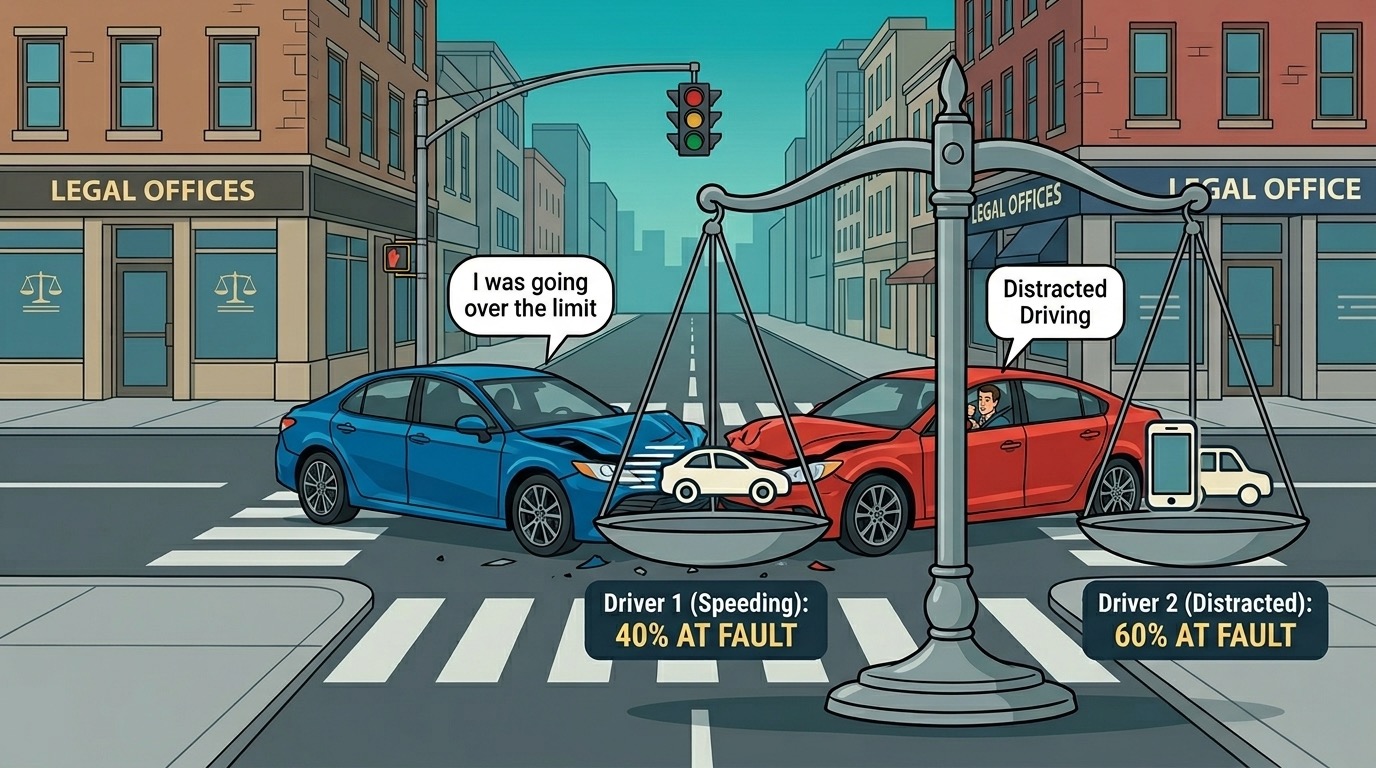
Example: You were traveling ten miles over the limit, but the other driver blew a red light while texting. The evidence might show you share 20 percent of the blame while they carry 80 percent. The key is how that story’s told. Facts don’t just sit there; they need someone to stand tall and explain what they mean in plain English.
Step 3 – Apply the Math (Recovery Formula)
That percentage translates directly into dollars. It’s simple arithmetic, but it hits hard.
If your case value is $100,000 and you’re 20 percent at fault, the court takes out that share:
$100,000 × (100 – 20%) = $80,000
A good lawyer doesn’t accept someone else’s math at face value. We dig into every assumption - how they arrived at 20 percent, what facts they skipped - because every five points matters to your family’s bottom line.
Step 4 – Understand the 51% Rule
In Texas and many other states, if that pie of fault tips past halfway - 51 percent or more your way - recovery stops cold. The law says you can’t be mostly responsible and still collect damages. That halfway line might sound like a tiny edge, but it separates a fair shot at justice from a shut door at the courthouse.
Pro Tip from Tall Chuck: “Percentages aren’t destiny - they’re arguments. Get someone who knows how to argue ’em right.”
The Human Side of Shared Fault
Legal numbers are one thing, but I never forget there’s a person behind every percentage.
Common Situations Where Good Folks Get Partial Fault
I’ve seen it all:
- Speeding a bit to get to day‑care pickup
- Distracted by singing kids in the back seat
- Fiddling with the radio or GPS for half a second
- Hitting unclear or hidden signage on unfamiliar roads
Those aren’t crimes. They’re life happening fast. The law just asks how those moments stacked up against someone else’s carelessness.
Why Insurance Companies Lean on Partial Fault
Adjusters love math that trims payouts. Their playbook says, “Find a little fault and multiply.” If they can pin 10 percent on you, that may shave thousands off their check.
So they’ll highlight your tiniest mistake while downplaying the drunk driver or broken traffic light. It’s their job to shrink the truth until it fits their balance sheets. Learn more about sharing the road with cyclists.
From my seven‑foot view, I see right through that number‑game - and we call it out, every time.
Emotional Reassurance
Partial fault doesn’t mean you’re a bad driver, folks. It means you’re human, same as the rest of us. The entire purpose of comparative negligence is to let life’s imperfections coexist with justice.
How Lawyers Fight to Reduce Your Fault Share
Now, here’s where Bennett Legal earns its keep - and where standing tall really begins.
Accident Reconstruction & Expert Testimony
We bring in engineers, reconstruction specialists, and sometimes former law‑enforcement pros to map the scene down to inches. Skid marks, brake timing, sight lines - those facts can shift a fault percentage dramatically.
Challenging Police Reports
A police officer’s initial call isn’t final. We cross‑check those observations against hard data, witness statements, and vehicle footage. Many reports list “contributing factors” that don’t equal legal fault. Context fixes the record.
Document Everything
Photos, dash‑cam videos, phone logs, text timestamps, eyewitness contacts - every shred covers your blind spots. Keep them organized; they’re gold when negotiations start.
Pro Tip from Tall Chuck: “We measure truth in tire tracks and timestamps - not assumptions.”
Having a lawyer who knows how to marshal that evidence means your story stands tall in front of people who’d rather shrink it down. And that’s how we make sure the math bends back toward fairness.
Legal Scenarios and Practical Examples
Alright folks, let’s trade the courtroom for real life a minute. Comparative fault sounds like fancy math, but it plays out in everyday wrecks that happen quicker than a blink.
Example 1: Speeding but Hit by a Red‑Light Runner
Let’s say you were going ten miles over the limit. The other driver plows through a red light and T‑bones your car.
The police list “unsafe speed” and “failure to obey traffic control” on the report.
In most comparative‑fault states, you’d be tagged for 20 percent responsibility, the other driver for 80 percent.
Your damage claim might be $100,000 in total. Your side collects $80,000 after the 20 percent reduction. That’s fair math; nobody gets away clean, but you still get back on your feet.
(Translation by Chuck: speeding’s a footnote when the other guy blew the whole chapter.)
Example 2: Rear‑Ended but Didn’t Signal Properly
Picture you slowing down to make a turn, but your blinker fizzled or timed out. The driver behind you was tailgating too close and hit your bumper.
Investigators decide you’re 30 percent at fault for no signal, while the tailgater carries 70 percent.
That 30 percent trim still allows compensation for medical bills and car damage - just lighter by your share. In some states with “pure comparative” systems (like California), you’d still be eligible even if the split was 49/51. In Texas, though, the minute your fault ticks above 50 percent, recovery noses into the guardrail.
Example 3: Multi‑Car Pile‑Up - Complex Shared Fault
Now take a rush‑hour chain crash - three cars, wet pavement, sudden braking.
One driver speeds, another follows too close, another fails to flash hazard lights.
Each insurance team claims they caused less than half the mess.
Courts may call it 33/33/34 percent or any mix that fits the facts. Expert reconstruction drawings, dash‑cam footage, and witness timing can swing those percentages by tens of thousands of dollars in value.
From up here, those numbers don’t look like math - they look like stories waiting for someone tall enough to see them whole.
Common Myths and Misconceptions
I spend a lot of time clearing up confusion about fault. Some of these myths are older than my cowboy boots, but they still cost folks real money.
Myth #1: “If I Apologize, I’ve Admitted Fault.”
Nope. Saying “I’m sorry” is human. It shows empathy, not liability. But adjusters sometimes twist it into an admission, so be careful with your wording. Keep it simple: “Is everyone okay?” You can be kind without confessing.
Translation by Chuck: “Apologies heal feelings, not court records.”
Myth #2: “Police Decide Fault for Good.”
Officers record observations, not verdicts. Their report helps, but courts and insurance investigations weigh it against photos, video evidence, and expert analysis. Never assume that initial checkbox means you’re done for. From my seven‑foot perspective, that report’s a starting line, not the finish. Learn more about how to prove your personal injury case.
Myth #3: “I Can’t Recover Anything if I Was Partly at Fault.”
That used to be true under old contributory laws, but not anymore in most of the country. In modified and pure comparative negligence states, partial fault reduces recovery - it doesn’t wipe it out. Even if you were 30 or 40 percent to blame, you still have rights, and those rights deserve representation.
Myth #4: “Insurers Treat Partial Fault Fairly.”
I’ll be blunt: Rarely.
Insurance companies use shared fault as a discount code for their own bills. They’ll highlight every small detail that makes you look culpable - from tire pressure to weather reports - and downplay their insured’s misconduct. That’s why having a lawyer makes the difference between math that short‑changes you and math that tells the truth.
Comparative negligence may sound like a numbers game, but behind every digit is a story of accountability and recovery. Knowing these myths helps you steer clear of the potholes that trip up honest drivers.
Next time somebody says you can’t collect because you were “partly at fault,” just remember - the law was written for humans, not robots. And humans can stand tall while still admitting a little imperfection.
Free consultation
Been in a truck accident?
Bennett Legal fights for maximum compensation. Free consultation.
On a Concluding Note
Folks, accidents happen to good people every day.
Sometimes we make quick choices - speed up to catch a green light, reach for a fallen coffee cup - and life spins sideways. But the law doesn’t exist to punish imperfection; it exists to keep fairness honest. Comparative negligence was built for moments just like those, so folks who made small mistakes still get a fair shake.
Grief, pain, and self‑blame can shrink a person faster than any insurance argument. Standing tall means not hiding from what happened; it means owning your truth and fighting for the justice you still deserve.
From up here I like to remind folks: this isn’t about blame, it’s about balance. The law calls it “apportionment of fault”; I call it making sure the scales don’t tilt too far against ordinary folks.
When your world feels knocked off its wheels, don’t shrink down and stay quiet. You’ve got rights, you’ve got proof, and you’ve got people ready to wrestle the math back into fairness.
Don’t Let Shared Fault Turn Into Shared Blame
If you take one thing away from all this, let it be this: being partly at fault does not mean you lose your right to justice.
Comparative negligence exists precisely because real life isn’t black and white. The problem is that insurance companies treat it like a weapon, not a balancing tool. They rush to assign percentages early, inflate your share of blame, and lock in numbers that quietly drain thousands from your recovery before you ever know what hit you.
That’s where most people get hurt the second time.
At Bennett Legal, we see it constantly - good drivers accepting unfair fault splits because they didn’t realize those numbers were negotiable, challengeable, and evidence-driven. Fault percentages aren’t facts carved in stone; they’re arguments. And whoever tells the story best usually controls the math.
Our role is simple but critical:
- We stop insurers from exaggerating your share of blame to protect their bottom line.
- We rebuild the accident story with evidence - crash data, expert analysis, timelines, and witness accounts - not assumptions.
- We protect your recovery under Texas’s 51% rule, making sure you’re not pushed over a legal line you don’t belong on.
- We fight for proportional fairness, so one human mistake doesn’t erase the value of your claim.
If you’ve been told you’re “partly at fault,” don’t assume the outcome is already decided. In many cases, that early label is just the opening move in a negotiation designed to make you settle for less.
Before you accept a percentage, sign a release, or let an insurer define what “fair” looks like - get someone in your corner who knows how comparative negligence actually works in the real world.
At Bennett Legal, we don’t let math get weaponized against people who were already knocked down. We step in early, straighten the story, and make sure responsibility is measured - not manipulated.
Tall Chuck’s Sign‑Off: “From where I’m standing, justice looks mighty tall. Reach out to Bennett Legal, and let’s make sure your side of the story stands just as tall.”
👉 Contact Bennett Legal for free guidance before you make a move.
Related Reading
Free consultation
Been in a truck accident?
Bennett Legal fights for maximum compensation. Free consultation.