If you need help, learn more about our Car Accident.
When you’re injured in a commercial truck accident, it’s not enough to simply tell your story.
Insurance companies will challenge the facts, trucking companies will have their own version of events, and without the right evidence in hand, your claim can be chipped away piece by piece.
In commercial truck accident lawsuits, evidence is your foundation.
It is what turns your experience into a compelling, provable case that can stand in negotiations or in front of a jury. And because trucking cases move fast, knowing what to gather and why can make the difference between a strong settlement and a denied claim.
Here’s the critical evidence you, and your lawyer, need, starting with one of the most overlooked, yet powerful tools in your arsenal.
10 Critical Evidence You Need to Present the Lawsuit
Let’s go over each, in detail, and also the common mistakes victims and loved ones are vulnerable to make under the stressful circumstances so it can be avoided.
Free consultation
Been in a truck accident?
Bennett Legal fights for maximum compensation. Free consultation.
1. Police Accident Report
The police accident report is the official written account from law enforcement documenting what happened at the scene.
It typically includes:
- The date, time, and exact location of the crash.
- Identification of all vehicles and drivers involved.
- Driver statements and witness statements taken at the scene.
- Notes on weather, road, and traffic conditions.
- Preliminary fault assessment or contributing factors observed by the officer.
- Citations issued (e.g., speeding, reckless driving, hours‑of‑service violations if noted).
In many states, commercial truck accidents trigger special investigative procedures, meaning the report may be more detailed than for a typical car accident.
Why It Matters in a Commercial Truck Accident Lawsuit
- Establishes a formal record: Adjusters, attorneys, and courts often treat police reports as the starting point for liability discussions.
- Officer observations carry credibility: Notes on driver behavior, visible cargo violations, skid mark patterns, or mechanical defects can support negligence claims.
- Evidence preservation: Event details captured immediately after the accident are far less likely to be influenced by later disputes or faded memories.
- Foundation for further investigation: The report can lead your legal team to additional evidence sources, like eyewitnesses or nearby businesses with surveillance footage.
In a commercial truck accident definition context, the police report may also clearly note the truck as a “commercial vehicle,” strengthening your claim’s classification and opening up broader legal avenues.
Common Mistakes Victims/Loved Ones Make
- Assuming the report is always correct, Officers do their best, but can miss key facts, especially when multiple vehicles are involved or hazards limit visibility.
- Not following up to get the report: Victims often wait too long, allowing claims adjusters to shape the narrative first.
- Failing to clarify inaccuracies: If witness names are misspelled or your account is incomplete, it can cause issues later.
- Overlooking supplemental reports: In serious crashes, especially with commercial trucks, multiple agencies may file separate reports (state police, DOT inspectors). These may contain crucial technical findings not in the primary report.
Practical Tips to Maximize Its Use
- Request the report as soon as possible: In some jurisdictions, police reports are available within days; in others, they take weeks. Track your request.
- Ask for ALL investigative documents: For commercial truck accidents, this may include inspection reports, cargo spill/inventory records, or hours‑of‑service compliance checks.
- Share it immediately with your attorney: They can spot missing details and request supplemental statements or corrections early.
- Collect your own scene notes and photos: These can help fact‑check the report and fill gaps.
- Follow up on citations: If the truck driver received a citation noted in the report, your lawyer can leverage that as strong liability evidence. Learn more about proving vicarious liability in truck accident cases.
Key Takeaway
The police accident report isn’t just paperwork, it’s a roadmap for your legal case.
It can point toward witnesses, violations, and conditions that will form the backbone of your lawsuit. But it’s only as strong as its accuracy, and mistakes can cost you. Acting quickly to obtain, review, and supplement the report is one of the smartest first moves you can make after a commercial trucking accident.
2. Driver’s Electronic Logging Device (ELD) Data
An Electronic Logging Device (ELD) automatically records a commercial driver’s hours of service, driving time, rest breaks, speed, and sometimes GPS location.
Federal law requires most commercial trucking companies to use ELDs to prevent dangerous fatigue and improve safety compliance. Learn more about bicycle safety awareness.
Why It Matters in a Commercial Truck Accident Lawsuit
- Proves driver fatigue: Exceeding federally mandated driving hours can directly establish negligence.
- Corroborates timelines: ELD data can confirm or challenge witness statements, police report times, and the driver’s own account.
- Links speed and location to the accident: GPS stamps show if the truck was speeding or off its intended route.
- Federal violations strengthen a claim: Hours‑of‑service breaches documented in ELDs can trigger regulatory penalties and bolster your lawsuit.
Common Mistakes Victims Make
- Not requesting ELD data quickly: By law, data can be overwritten or lost if not preserved.
- Assuming trucking companies will provide it voluntarily: Many will delay or refuse unless compelled by legal order.
- Failing to link ELD violations to the accident’s cause: Fatigue data matters most when directly tied to driver error that led to the crash.
- Overlooking GPS movement history: This can reveal dangerous driving before the accident.
Practical Tips
- Ask your lawyer to send a preservation letter immediately to the trucking company demanding ELD data retention.
- Compare ELD logs with weight station entries, fuel receipts, and GPS records: Inconsistencies can be evidence of falsification.
- Check state inspection results: Enforcement agencies sometimes download ELD data after a crash and include it in reports.
Key Takeaway
ELD data can be the smoking gun in a commercial truck accident case, proving fatigue, speeding, or route violations. But acting fast is essential, delay can erase the proof you need.
3. Maintenance & Inspection Records
Every commercial truck must undergo regular maintenance and inspections under FMCSA and state regulations.
These records document:
- Brake checks
- Tire replacements
- Engine diagnostics
- Safety system repairs
- Annual DOT inspections
Why It Matters
- Shows mechanical negligence: If worn brakes or bald tires contributed to the accident, liability may shift from the driver to the trucking company or maintenance provider.
- Reveals ignored safety issues: Records showing repeated problems without repair are powerful negligence evidence.
- Identifies secondary liable parties: Maintenance contractors or fleets can be sued alongside the trucking company.
Common Mistakes Victims Make
- Not realizing these records exist: Many assume the police report covers all mechanical info.
- Failing to secure them early: Companies may “lose” problem records if the request is delayed.
- Ignoring third-party contractors: Outsourced maintenance firms can also be liable.
- Not comparing records to FMCSA inspection requirements: Missing mandated checks can be a legal breach.
Practical Tips
- Request full maintenance logs for at least 12 months before the crash.
- Cross-reference repairs with accident cause, e.g., brake failures noted months before the crash.
- Subpoena third-party maintenance contracts, they may reveal cost-cutting that skipped essential work.
Key Takeaway
Maintenance records can turn a “driver error” case into a “company negligence” case, expanding liability and insurance coverage.
4. Cargo Loading Documents
Commercial cargo documentation includes:
- Bills of lading (who shipped, weight, destination)
- Load manifests
- Hazardous materials declarations
- Weight tickets from scales
These prove how the truck was loaded and whether it complied with safety laws.
Why It Matters
- Shows unsafe load conditions: Overweight or poorly secured loads cause rollovers, jackknifes, or spill hazards.
- Identifies additional liability parties: Cargo loading companies, shippers, or warehouses can be sued for improper handling.
- Connects violations to accident cause: Cargo shifts during travel can severely affect braking and control.
Common Mistakes Victims Make
- Ignoring cargo company involvement: Many assume liability is only with the trucking firm.
- Overlooking hazardous cargo: Hazmat rules are stricter, and violations can amplify damages.
- Failing to get photographic evidence at the scene: Proving a shifted or spilled load is easier with visuals.
- Not checking compliance with FMCSA cargo securement rules.
Practical Tips
- Get cargo weigh-in records from inspection stations; they timestamp loading weight.
- Hire an accident reconstruction expert familiar with cargo impact physics.
- Preserve any photos taken before cargo cleanup at the scene; trucking companies often remove evidence quickly.
Key Takeaway
Cargo records can widen your lawsuit’s scope and bring in deep-pocket defendants, crucial in major injury cases.
5. Witness Statements
Witness statements are verbal or written accounts from people who saw the crash or events leading up to it.
They may come from:
- Drivers of nearby vehicles
- Pedestrians
- First responders
- Business employees near the scene
Why It Matters
- Supports your version of events against conflicting driver testimony.
- Can catch details police miss, like a driver texting before impact.
- Adds credibility, juries often find unbiased eyewitnesses persuasive.
Common Mistakes Victims Make
- Waiting too long to get statements: Memories fade quickly, and details get lost.
- Relying only on police-collected witness info: Officers may not document full accounts.
- Not verifying contact info: Losing track of witnesses makes them unusable later.
- Failing to prepare witnesses: Without preparation, they may provide incomplete or inconsistent testimony.
Practical Tips
- Get names, numbers, and emails immediately at the scene if possible.
- Request written accounts early while memories are fresh.
- Ask your lawyer to follow up professionally, witness interviews are best done under legal guidance to avoid contamination of testimony.
Key Takeaway
A credible witness can make an insurer rethink its denial or low offer, but only if you secure and protect their testimony early.
6. Photos & Videos from the Scene
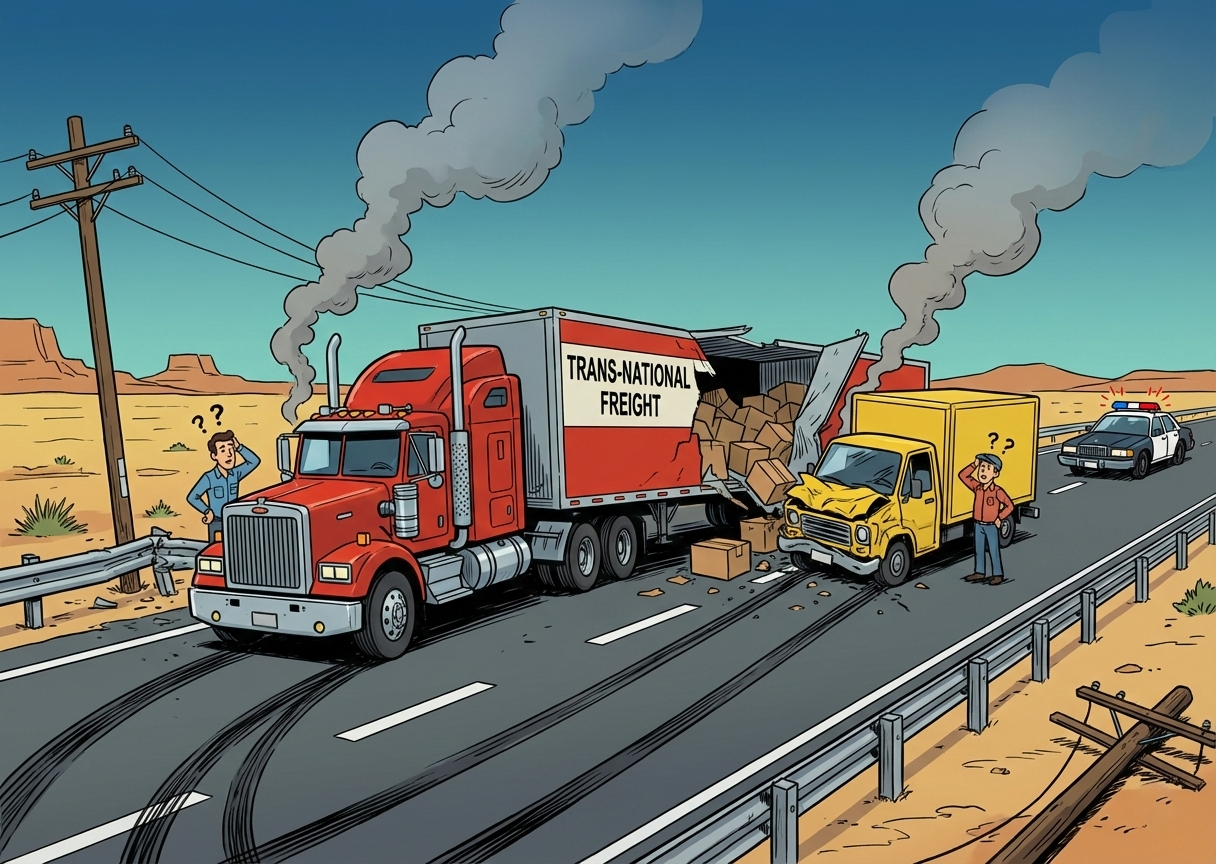
Photographic and video evidence captures the visual reality of the accident:
- Vehicle positions and damage
- Skid marks and debris fields
- Road conditions (wet pavement, poor lighting)
- Weather at the time of the crash
- Cargo spills or overturned trailers
These visuals can come from your phone, bystanders, dashcams, or even first responders’ documentation.
Why It Matters
- Provides irrefutable proof: Images can show angles, distances, and positions that words alone can’t convey.
- Counteracts altered narratives: Visuals prevent defendants from misrepresenting vehicle positioning or accident severity.
- Reconstruction aid: Accident experts use photos and videos to model crash dynamics.
- Supports damage claims: Photos of injuries, vehicle destruction, and scene hazards can influence settlement amounts.
Common Mistakes Victims Make
- Waiting to take photos: The scene changes quickly once cleanup begins.
- Only photographing close‑ups: Wide‑angle context is crucial.
- Failing to capture conditions: Lighting, signage, and road defects matter to liability.
- Missing metadata: Timestamps and GPS data validate authenticity.
Practical Tips
- Photograph from multiple angles (front, side, rear) for all vehicles involved.
- Include surroundings: traffic signs, nearby businesses, construction areas.
- Back up files immediately: upload to cloud storage to prevent loss.
- Collect any bystander footage: ask permission to obtain copies.
Key Takeaway
Photos and videos freeze the truth in time: and truth is your best defense when others try to rewrite the story.
7. Accident Reconstruction Expert Reports
Accident reconstruction experts use science, engineering, and math to rebuild the crash in detail.
Reports may include:
- Vehicle speed estimates
- Angle of impact
- Braking distances
- Cargo movement effects
- The sequence of collisions in multi‑vehicle accidents
Why It Matters
- Provides objective analysis: Experts offer unbiased technical conclusions.
- Clarifies liability: Pinpoints specific actions that caused the accident.
- Strengthens court cases: Judges and juries often rely heavily on technical testimony.
- Reveals unseen factors: Mechanical failures, visibility issues, or driver reaction times.
Common Mistakes Victims Make
- Not hiring an expert early: Critical scene evidence can be lost without prompt analysis.
- Choosing inexperienced experts: Trucking cases require familiarity with FMCSA standards.
- Failing to provide complete data: Missing ELD logs, maintenance records, or photos weaken findings.
Practical Tips
- Engage experts within weeks of the crash, before road repairs or vehicle disposal.
- Use specialists with commercial trucking credentials, they understand cargo impact, trailer physics, and trucking regs.
- Coordinate expert findings with witness accounts for maximum credibility.
Key Takeaway
Accident reconstruction turns chaos into clarity, a map of exactly how negligence led to destruction.
8. Trucking Company Safety Records
Safety records detail the company’s operational history and compliance track record. These may include:
- Prior accident reports
- FMCSA safety audit results
- Driver hiring and training policies
- Disciplinary records and termination history
- Maintenance compliance logs
Why It Matters
- Shows negligence patterns: Repeated violations strengthen claims for recklessness.
- Supports punitive damages: Courts may award extra damages for ongoing disregard of safety laws.
- Reveals systemic issues: Poor hiring or training practices that contribute to unsafe driving.
Common Mistakes Victims Make
- Ignoring the company’s history: Victims often focus only on the crash at hand.
- Not requesting public FMCSA reports: many safety records are available online.
- Failing to connect history to your case: prior incidents must relate to similar causes.
Practical Tips
- Request FMCSA Safety Measurement System (SMS) data for the company.
- Compare hiring policies to legal standards; did they employ unqualified drivers?
- Ask for training materials used during onboarding; outdated or insufficient content can be negligence evidence.
Key Takeaway
A trucking company’s safety record is its résumé, and a bad résumé can be your strongest argument in court.
9. Medical Records & Treatment Plans
Medical documentation includes:
- ER records
- Diagnostic imaging
- Surgery reports
- Physical therapy logs
- Prognosis statements from doctors
- Medication history
Why It Matters
- Proves injury severity: Directly links accident trauma to current medical needs.
- Establishes damages: Supports claims for cost of care, rehab, and lifestyle changes.
- Shows permanence: For catastrophic injury claims, ongoing treatment is key proof.
Common Mistakes Victims Make
- Delaying treatment gaps weaken cause‑and‑effect arguments.
- Incomplete records omitting rehab notes or specialist visits.
- Not tracking future care needs settlements can fall short if future expenses aren’t documented.
Practical Tips
- See medical providers immediately and regularly; continuity matters.
- Keep pain and recovery journals useful for non‑economic damages claims.
- Request detailed treatment plans with cost estimates from each provider.
Key Takeaway
Medical records are the bridge between accident and compensation; the more thorough they are, the stronger your claim.
10. Surveillance or Dashcam Footage
Video evidence from:
- Traffic cameras
- Business security systems
- Truck’s own dashcam
- Other vehicles’ dashcams
Why It Matters
- Captures incident in real time: Shows exactly what happened without bias.
- Can disprove false claims: Contradicts fabricated driver or witness accounts.
- Often decisive in settlement talks; insurers rarely fight against clear footage.
Common Mistakes Victims Make
- Not requesting footage early; many systems overwrite within days.
- Assuming police will collect all footage; they may only secure public cams.
- Failing to authenticate footage; courts require proof of source and unaltered status.
Practical Tips
- Identify potential camera sources immediately, nearby businesses, public transport, traffic lights.
- Send evidence preservation letters to those sources.
- Work with your attorney to secure official copies that meet court admissibility standards.
Key Takeaway
Video doesn’t flinch, forget, or fabricate, but only if you secure it before it’s gone.
11. Black Box (Event Data Recorder) Information
Many commercial trucks are equipped with Event Data Recorders (EDRs) - often called “black boxes,” similar to those in airplanes.
These devices store critical pre‑ and post‑crash data, including:
- Speed at impact
- Brake application timing
- Engine RPMs
- Throttle position
- Seatbelt usage
- Sudden steering inputs
Some systems also capture information about mechanical faults detected right before the crash.
Why It Matters
- Shows precise driving behavior moments before impact - far more reliable than human recollection.
- Identifies mechanical malfunctions that may have contributed to the crash.
- Corroborates or contradicts driver statements about speed, braking, or evasive action.
- Helps accident reconstruction experts build a detailed technical timeline.
Common Mistakes Victims Make
- Not knowing black box data exists: It’s often hidden from public knowledge.
- Failing to get a preservation order quickly: Data may auto‑overwrite after a set period or be intentionally wiped.
- Neglecting to hire an expert to interpret the data: Raw EDR files require technical expertise.
Practical Tips
- Act fast; have your lawyer send formal demands for EDR preservation immediately.
- Hire a qualified crash data retrieval technician; they can extract and interpret properly.
- Match black box data to other evidence sources like ELD logs and dashcam footage for consistency.
Key Takeaway
Black box data is pure, unbiased truth - but it’s fragile. Secure it quickly or risk losing proof that could decide your lawsuit.
12. Financial and Employment Records
Documentation of your pre‑ and post‑accident income, work history, and benefits, including:
- Pay stubs
- Tax returns
- Employer HR files
- Benefits statements (health, retirement, disability)
- Job performance reviews
Why It Matters
- Quantifies economic loss: Shows exactly how the accident harmed your earning ability.
- Supports lost wages and future earning capacity claims.
- Adds weight to catastrophic injury cases; evidence of permanent inability to return to work.
Common Mistakes Victims Make
- Failing to collect proof of pre‑accident earnings; without a baseline, losses are harder to calculate.
- Leaving out benefits and perks; bonuses, health insurance, and retirement contributions all have value.
- Not documenting attempts to return to work; employers may dispute your inability if no return attempt is shown.
Practical Tips
- Gather at least 3 years of pre‑accident records - show consistent earning history.
- Include fringe benefits in your claims - these often add substantial value.
- Work with a vocational expert to project your career path without injury.
Key Takeaway
Commercial truck accident lawsuits don’t just compensate for medical bills - they address how your career and earnings have been cut short. Proving the full scope of loss is essential to getting what you deserve.
Bennett Legal Turns Evidence Into Victory
In a commercial truck accident lawsuit, evidence isn’t just important - it’s everything. It’s the photos that show how the truck blocked your lane, the black box data that proves the driver didn’t brake, the maintenance records revealing ignored safety warnings, and the medical files that tell the story of how your life changed forever. Learn more about mistakes to avoid after a truck accident.
The truth is, trucking companies and their insurers often have entire teams working to control the narrative before you’ve even left the hospital. They know exactly which records to hide, which logs to alter, and which witnesses to contact first.
If you don’t move quickly and strategically, crucial proof can slip away - and so can the compensation you need for medical care, lost income, and rebuilding your life.
At Bennett Legal, we:
- Demand preservation of all evidence - from ELD data to black box downloads - before it disappears.
- Subpoena company safety records, hiring histories, and cargo manifests to build a case that reaches every liable party.
- Work with top accident reconstruction experts to turn complex data into clear, compelling courtroom arguments.
- Fight back against insurance delay tactics, ensuring your lawsuit moves on your timeline - not theirs.
We’ve handled trucking accident cases from Texas to California to New Jersey, securing results that reflect the full scope of our clients’ losses - from lifetime care needs to lost earning potential.
📞 Contact Bennett Legal today for a free, no‑obligation case evaluation.
Your future after a commercial truck accident depends on proving what happened - and we’ll make sure the evidence tells your story, powerfully and completely.
Related Reading
Free consultation
Been in a truck accident?
Bennett Legal fights for maximum compensation. Free consultation.