Solar panel fraud targeting older adults is rising at an alarming rate. Many adult children only discover the problem after their parent mentions unexpected bills, receives notices from a lender, or reveals a long‑term lease they didn't fully understand. (If you're just learning how long these contracts last — and what happens when they outlive the homeowner — our guide on whether a solar panel contract can outlive you is essential background.)
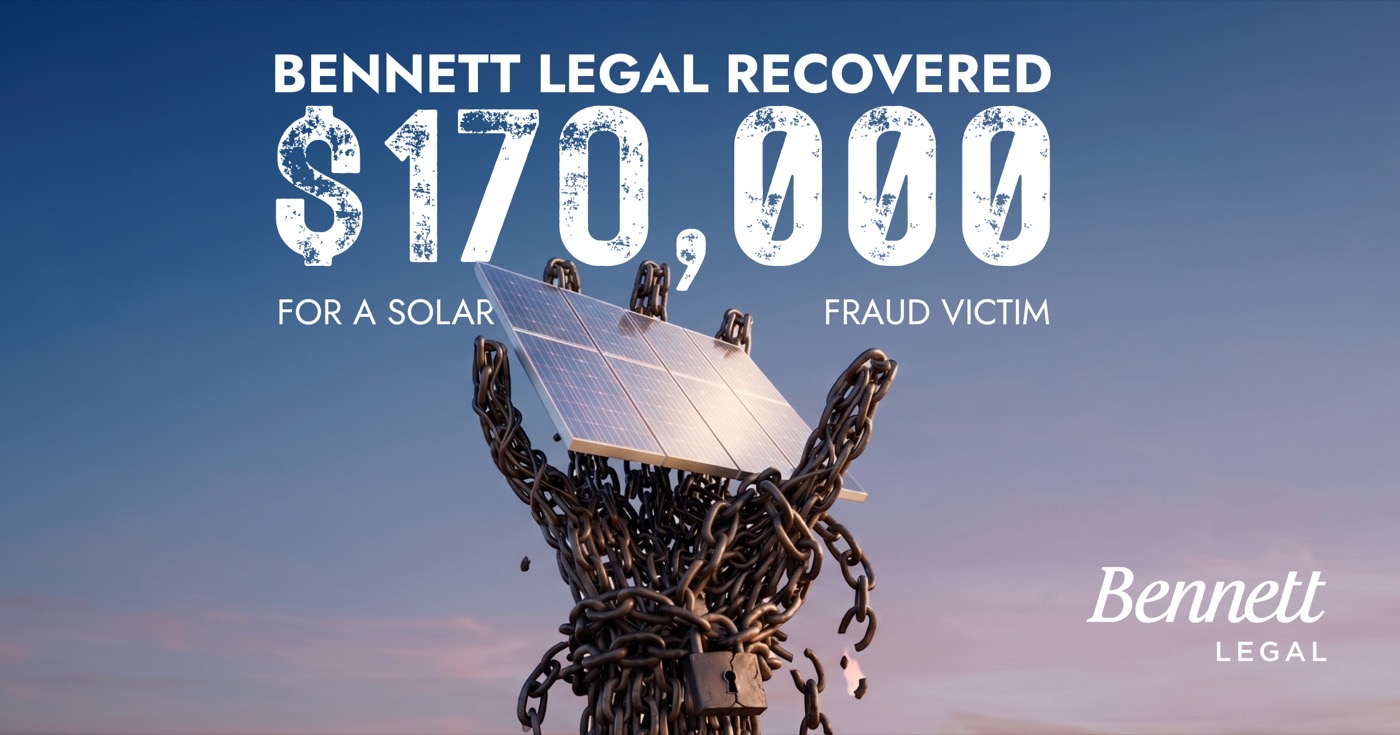
$170,000+ recovery
Against Sunlight Financial · Solar fraud arbitration
- $113,000 loan cancelled
- UCC lien removed
- Credit repaired
- $58,000 cash to client
Past results do not guarantee a similar outcome. Every case is different.
If you suspect your parent was pressured, misled, or taken advantage of during a solar sale, you're not alone — and you do have options.
This guide walks you through the steps you can take right now to protect your parent, their home, and their financial future.
Free consultation
Solar panel contract problems?
We help homeowners fight back against solar fraud. Free consultation.
How Solar Panel Fraud Targets Older Adults
Fraudulent and misleading solar contracts often begin with a friendly salesperson at the door who claims the panels are "free," "backed by the government," or "guaranteed to lower bills." These are among the most common lies in the predatory solar sales playbook — tactics that the U.S. Department of the Treasury, CFPB, and FTC have all warned consumers about. Older homeowners are frequently singled out because they are more likely to be at home during the day, more trusting of "official‑sounding" programs, and less familiar with complex financing structures like PPAs, solar leases, and UCC‑1 filings.
Common consequences your parent may be facing:
- A 20–30 year lease or PPA they didn't realize they signed
- A high‑interest solar loan they can't afford
- A UCC‑1 filing (security interest) attached to the home
- A lien that disrupts refinancing, property transfers, or future inheritance
- Misrepresented utility savings that never materialized
If you see any of these issues, you're already on the right track by looking deeper.
First Steps for Adult Children When Solar Panel Fraud Is Suspected
 Elder homeowners worried due to increasing solar energy bills
Talk With Your Parent and Gather Information
Many older adults feel embarrassed or confused about what happened. Approach the conversation with patience, not panic. Ask:
- What did the salesperson say?
- Did anyone promise "free solar panels"?
- Did they sign electronically or on a tablet?
- Were they rushed?
- Do they know if they signed a lease, PPA, or loan?
Even partial memories help identify possible misrepresentations. Write everything down while it's fresh — your parent's account of what happened during the sale is potential evidence.
Collect All Relevant Solar Documents
Gather every document you can find, including:
- Solar lease or PPA
- Loan contract
- Promissory notes
- UCC‑1 filings
- Lien notices
- Recorded documents
- Emails, texts, brochures
Your next steps depend on the type of agreement and whether a security interest has been recorded. If you're not sure what kind of deal your parent signed, our guide on what solar panel financing fraud actually looks like can help you sort through the paperwork.
Learn the Red Flags of Fraud
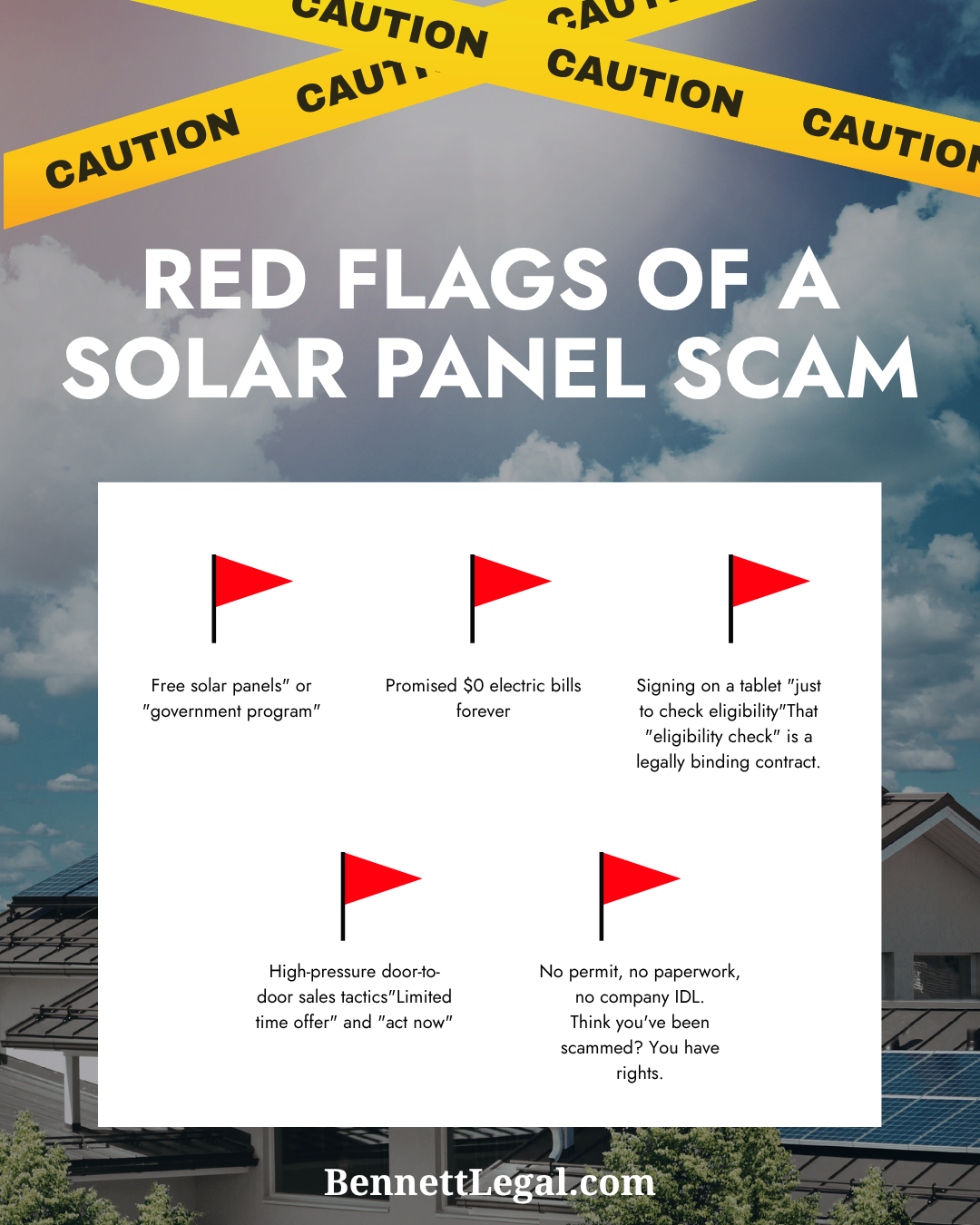 Red flags of solar panel fraud
Many adult children notice something is wrong but aren't sure how to confirm it. Common red flags include:
- The salesperson said the panels were "free" or "government‑funded"
- Your parent was told they'd "never pay an electric bill again"
- The contract was signed the same day the salesperson showed up
- Your parent doesn't remember signing, or the signature looks off
- Monthly payments are higher than the old electric bill
For a complete breakdown of misleading claims and fraud indicators, see our guide on how to spot the red flags in a solar panel contract.
Check for a Filed Security Interest (UCC‑1)
A security interest gives the lender the right to repossess equipment, block transfer of the home, or refuse lien removal. You can check through:
- Your state's Secretary of State database
- Your county recorder's office
If a UCC‑1 was filed without your parent understanding the contract, that's a major red flag — and potentially a powerful piece of evidence.
Review Home Title and Ownership Structure
This affects how solar obligations travel after death. Common structures include joint tenancy, tenancy in common, beneficiary deeds, and sole ownership. These influence probate, creditor claims, and whether the solar contract sticks to the property.
If you're not sure how your parent's home is titled, a quick check with the county clerk's office or a real estate attorney can clear it up.
Worried your parent may have been pressured into a bad solar deal? Bennett Legal helps families investigate solar panel fraud and fight back against misleading contracts. Request a free, confidential case review.
Legal Rights Your Parent May Still Have
Cooling‑Off Rules and Door‑to‑Door Protections
Your parent may be protected under:
- The FTC Cooling‑Off Rule (3‑day cancellation for door‑to‑door sales)
- State solicitation laws
- Solar‑specific disclosure requirements in states like CA, AZ, TX, FL, and NJ
Even if the 3‑day window has passed, other protections may still apply — especially if the salesperson made false claims or failed to provide required disclosures. In Texas, Senate Bill 1036 has required covered residential solar contracts to include a 5-business-day cancellation right and full-cost disclosure since September 1, 2025, and, as of September 1, 2026, also requires solar salespeople and their companies to register with the state — companies that break these rules face fines up to $50,000 per violation, or $100,000 if the victim is 65 or older. None of that rewrites a contract your parent already signed, though — here's exactly what the new law does and doesn't change for an existing contract.
Consumer Protection Statutes (UDAP Laws)
Every state has some version of Unfair and Deceptive Acts and Practices (UDAP) laws. In Texas, the Deceptive Trade Practices Act (DTPA) is particularly strong. These statutes allow consumers to:
- Cancel fraudulent contracts
- Recover financial losses
- Seek attorney's fees
- Challenge forged or unauthorized signatures
If the company's conduct was intentional, courts can award up to three times the actual damages — plus legal fees. These laws exist specifically for situations where someone was misled into a deal they didn't understand.
Legal Defenses Commonly Used for Elderly Fraud Victims
Attorneys fighting solar panel fraud on behalf of older adults have several legal tools available. In plain terms, your attorney may argue that:
- Misrepresentation — the salesperson lied about the deal
- Fraud in the inducement — your parent was tricked into signing
- Unconscionability — the terms are so one‑sided they shock the conscience
- Lack of capacity — your parent may not have been in a position to understand what they were signing
- Undue influence — high‑pressure tactics that overrode your parent's free will
These defenses are especially effective when the deal was rushed, signed electronically, or completed in a single visit — patterns that are common in predatory solar sales operations.
Options If Your Parent Wants to Cancel the Solar Contract
If your parent wants out of the deal, the following paths may be available depending on the specifics of the contract and your state's laws:
- Request cancellation due to misrepresentation
- Assert UDAP or DTPA violations
- Use cooling‑off periods (if still within the window or if proper notice was never given)
- Challenge forged or unauthorized signatures
- Invoke elder protection statutes
- Request contract rescission
- Dispute the solar loan under the FTC Holder Rule
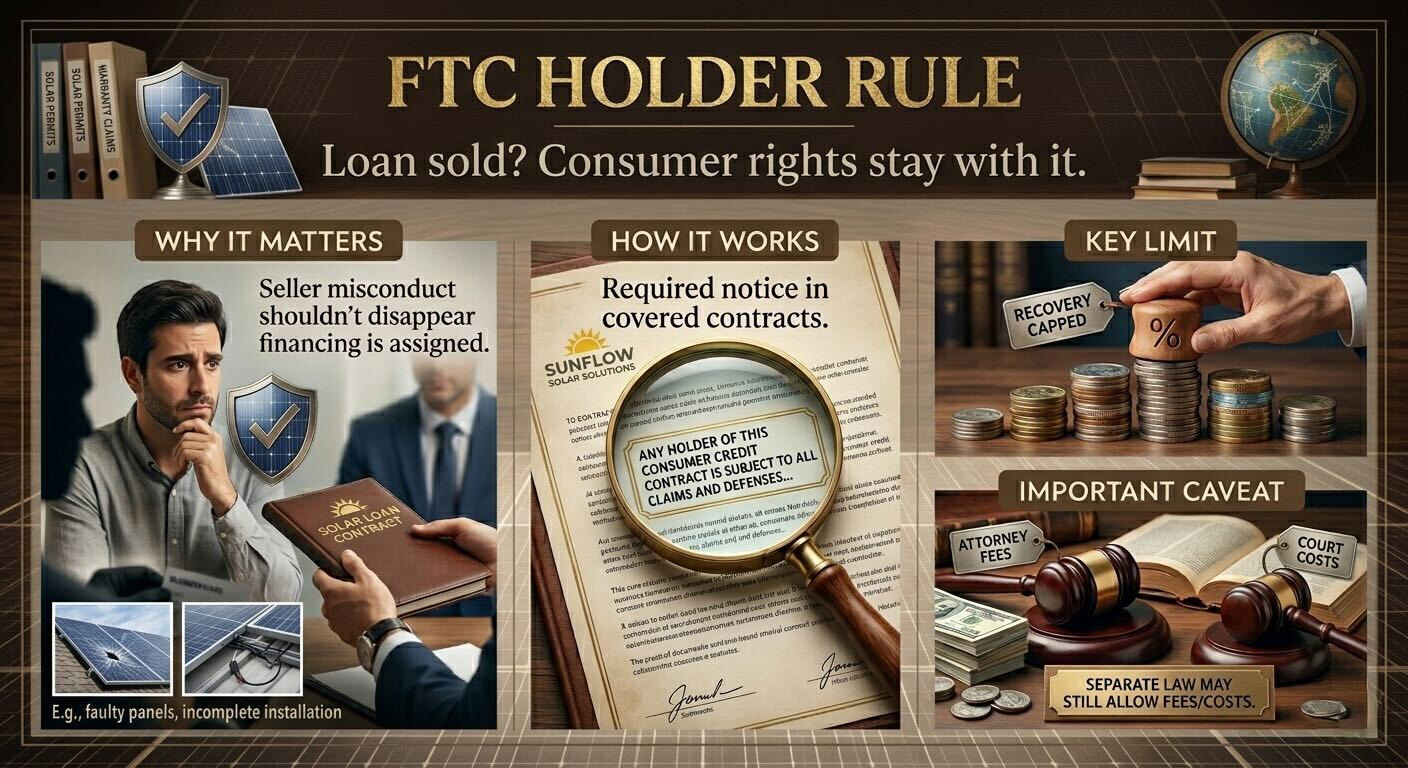 What is the FTC Holder Rule
Not every option applies in every case. A consumer protection attorney can help you identify the strongest path forward based on the contract, the sales conduct, and the applicable law. For a broader walkthrough of the cancellation process, see our guide on how to get out of a solar panel contract.
Understanding the Three Types of Solar Agreements
Not all solar contracts work the same way — and the type of agreement your parent signed determines who holds the lien, how hard it is to cancel, and what happens to the obligation after death. Here's how the three most common structures compare:
| Factor | Solar Lease | Power Purchase Agreement (PPA) | Solar Loan |
|---|---|---|---|
| Who owns the panels | The leasing company | The PPA provider | The homeowner (after payoff) |
| Typical term | 20–25 years | 20–25 years | 10–25 years |
| Monthly payment based on | Fixed monthly fee (may escalate) | Per-kWh rate for energy produced | Loan principal + interest |
| UCC-1 / lien filed | Yes — company protects its equipment | Yes — company protects its equipment | Often yes — lender secures the loan |
| Cancellation difficulty | High — early termination fees, company must agree | High — similar to lease, tied to energy production | Moderate — payoff or dispute under FTC Holder Rule |
| What happens at death | Lease transfers to estate or new owner; may require assumption | PPA transfers with the property; heirs may need to assume or negotiate | Debt becomes estate obligation; lien remains until resolved |
| Heir personal liability | Generally no — but property carries the obligation | Generally no — but property carries the obligation | Generally no — but lien can block sale or transfer |
Understanding which type of agreement your parent signed is critical. A lease or PPA means someone else owns the equipment on your parent's roof. A loan means your parent technically owns the panels — but the lender may have a security interest that functions much like a lien. In all three cases, the obligation can follow the property and create problems for heirs.
What Adult Children Should Do Before Their Parent Passes Away
 Check for a UCC-1 lien on the solar contract
This is the part nobody wants to think about — but acting while your parent is alive and can participate makes a significant legal difference.
Decide Whether Payments Should Continue
Stopping payments may trigger collection threats or credit damage; continuing may be financially unrealistic. The right answer depends on whether the contract is enforceable in the first place. Don't make this decision alone — an attorney can help you weigh the risks.
Communicate With the Solar Company or Lender in Writing
Written communication helps establish a record. Request:
- The original signed contract
- Proof of signature (especially if electronic)
- Proof of disclosures provided at signing
- Full payment history
Keep copies of everything you send and receive.
Address Title Issues Early
If a lien or UCC‑1 exists, it may block a sale of the home, a refinance, or adding heirs to the title. Resolving these issues while your parent is alive — and can provide testimony about what happened during the sale — is far easier than doing it through probate.
If your parent is still alive and able to participate, that's a legal advantage. Their testimony about what the salesperson said, how they were pressured, and what they understood is powerful evidence. Don't wait until that window closes. Contact Bennett Legal for a free case evaluation.
What Happens If Your Parent Has Already Passed Away: Solar Panel Inheritance
 Solar panels on a house — what happens when you inherit a home with solar
When a parent dies with an active solar agreement, the question of solar panel inheritance becomes urgent. Who is responsible for the contract? Can heirs be forced to keep paying? Does the lien block the sale of the home?
Whether Solar Debt Transfers to Heirs
Heirs typically do not assume personal liability for a parent's solar contract or loan. However, the property itself may inherit the obligation — meaning the panels, the lease, or the lien can follow the house.
How Liens and Security Interests Affect Inherited Homes
A lender may refuse to remove a lien until the contract is resolved. This can block a sale or make the property harder to transfer. Probate can force resolution, but that takes time and legal work.
Probate and Non‑Probate Transfers
Outcomes differ depending on how the home was held:
- Joint tenancy — property passes automatically, but the contract may still attach
- Tenancy in common — the deceased's share goes through probate
- Beneficiary deeds — transfer occurs outside probate, but creditors may still have claims
- Full probate — the estate handles creditor claims on a set timeline that varies by state
Small Estate Affidavits
These can simplify the transfer of smaller estates, but creditors still have the right to file claims. Don't assume a small estate process avoids the solar issue entirely.
What to Do If You Inherit a Home With a Fraudulent Solar Lease
This situation involves more legal steps than a single article can cover — including probate, creditor claims, lien disputes, and contract challenges that all need to happen in the right order.
See our dedicated guide: What to Do If You Inherit a Home With a Fraudulent Solar Lease
When It's Time to Call a Consumer Protection Attorney
You might be able to handle some early steps on your own — gathering documents, checking for liens, and talking with your parent. But you probably need an attorney if:
- The solar company won't respond to cancellation requests
- Signatures appear forged or your parent says they didn't sign
- A lien is blocking a sale or refinance
- Your parent had impaired capacity at the time of signing
- You need help challenging the lender or disputing the loan
- The company is threatening repossession of the panels
A consumer protection attorney who understands solar fraud can evaluate the contract, identify the strongest legal theories, and push back on companies that are counting on families to give up.
Frequently Asked Questions
Can a solar company take the panels if my parent stops paying?
Yes, if a security interest (UCC‑1) exists, the lender may have the right to repossess the equipment. But state laws limit how and when removal can happen, and the process usually requires proper notice. If the contract itself was fraudulent, repossession rights may not be enforceable at all.
Can heirs be forced to take over a parent's solar loan?
No. Heirs rarely inherit personal liability for a parent's solar debt. The obligation may attach to the property, but that doesn't mean you personally owe the money. An attorney can help you understand what the estate does and doesn't owe.
How do I check for a lien or UCC filing on my parent's home?
Search your state's Secretary of State database for UCC filings and check with your county recorder's office for any recorded liens. Many of these searches can be done online. If you're unsure what you're looking at, bring what you find to an attorney.
Can a fraudulent solar lease be canceled after the homeowner dies?
Often, yes — especially when the contract was induced by deceptive practices, the homeowner lacked capacity, or required disclosures were never provided. The estate or heirs may have standing to challenge the contract through probate or a separate legal action.
Do solar liens stay with the property after someone dies?
They can — but many can be challenged or removed during the estate process, especially if the underlying contract was fraudulent. Don't assume a lien is permanent just because it's on the title.
What if the solar panels I inherited were based on a fraudulent contract?
If the original contract was induced by deceptive sales practices — false promises, forged signatures, or pressure tactics targeting an elderly homeowner — the fraud doesn't become untouchable just because the homeowner has passed away. The estate or heirs may have standing to challenge the contract, seek rescission, or pursue damages under consumer protection laws. An attorney can evaluate the original sales conduct and advise on the strongest path forward. For a broader look at how solar obligations transfer after death, see: Can a Solar Panel Contract Outlive You?
Does the direction my panels face affect whether I have a fraud case?
It can. If panels were installed on a north-facing roof without disclosure — and the company promised significant savings — that failure to disclose the impact on production is relevant to claims under consumer protection statutes. Panel orientation can be a material fact in proving that the company's promises were misleading.
If this article sounds like your family's experience, you're not alone — and you have rights. Contact Bennett Legal for a free, confidential review of your parent's solar contract and situation.
Related Articles from Bennett Legal
- Can a Solar Panel Contract Outlive You? What It Means for Your Family and Your Home
- 7 Red Flags That Could Mean Your Solar Panel Contract Is a Scam
- What Is Solar Panel Financing Fraud?
- The Solar Panel Sales Playbook: High-Pressure Tactics That Signal Fraud
- How Do I Get Out of My Solar Panel Contract?
- Best Direction for Solar Panels: If Your Panels Face North, It Could Be a Red Flag
- How to Spot a Predatory Solar Panel Financing Deal
Bennett Legal | BennettLegal.com | Dallas, Texas
Free consultation
Solar panel contract problems?
We help homeowners fight back against solar fraud. Free consultation.