You wanted lower utility bills. You wanted to invest in your home. You wanted clean energy.
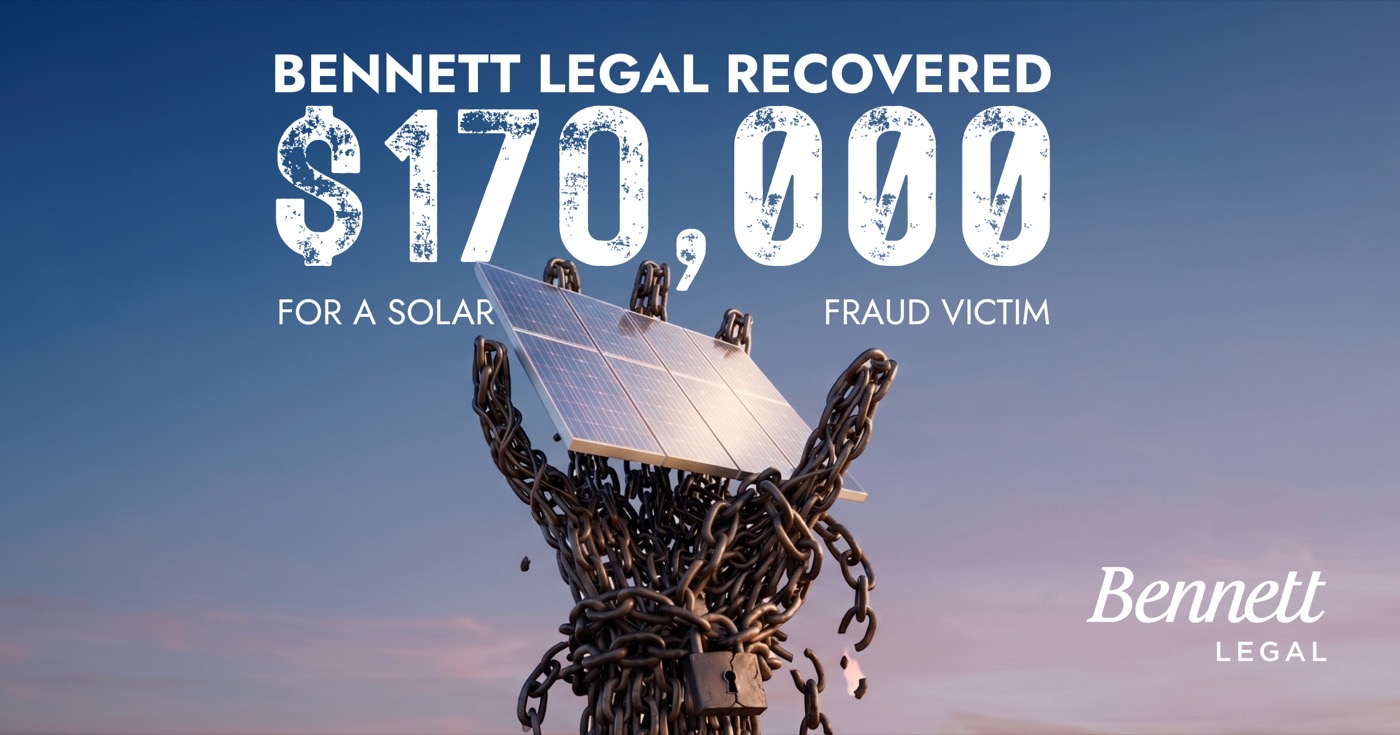
$170,000+ recovery
Against Sunlight Financial · Solar fraud arbitration
- $113,000 loan cancelled
- UCC lien removed
- Credit repaired
- $58,000 cash to client
Past results do not guarantee a similar outcome. Every case is different.
Instead, you may now be staring at a solar contract you cannot escape, payments that climbed without warning, or a lien blocking your ability to sell or refinance your home.
If you are looking into solar panels or already feel trapped in a bad agreement, this guide shows you exactly how predatory solar financing works, the scams spreading in 2026, and the warning signs that protect you before it is too late.
Free consultation
Solar panel contract problems?
We help homeowners fight back against solar fraud. Free consultation — no fees unless we win.
11 Red Flags of a Predatory Solar Panel Financing Deal
Below are the eleven red flags that show a solar financing deal may be abusive, deceptive, or illegal — and what you can do right now to protect yourself.
1. A financing structure designed to benefit the lender, not you
Many predatory solar financing deals are engineered so the company profits even if you do not. Common traps include interest rates far above industry norms, hidden dealer fees built into the loan amount, payment schedules that escalate over time, and financing terms longer than the expected life of the equipment.
These structures often double or triple the real cost of the system. A homeowner who thinks they are paying $25,000 for panels may discover the total financed amount is $55,000 or more once dealer fees, interest, and escalators are factored in. If the math does not make sense, the deal was designed that way. For a detailed breakdown of how dealer fees inflate costs differently across solar leases versus loans, see our companion guide.
2. Numbers that do not add up — fake savings, fake projections
Sales reps often promise zero utility bills, lifetime savings, guaranteed tax credits, and unrealistic timelines for "paying off" the system. In many cases, these claims are impossible. Solar savings vary by region, roof angle, weather, utility rates, and usage patterns. There is no universal savings formula, and companies that pretend otherwise are hiding something.
One of the most common deceptions involves tax credit misrepresentation. Reps tell homeowners they will receive a specific dollar amount back from the federal solar tax credit without verifying whether the homeowner has enough tax liability to claim it. When the credit falls short, the homeowner is stuck with payments they were told the credit would cover.
3. Confusing or overly complex contracts
Predatory contracts bury the danger in adjustable interest rates, balloon or lump-sum payments, prepayment penalties, escalating lease and loan multipliers, hidden add-ons such as service fees or monitoring charges, and UCC-1 liens that stay attached to your property.
You should be able to read your contract without guessing. If you need a magnifying glass and a finance degree to understand the terms, that complexity is intentional. A legitimate financing agreement states the total cost, the interest rate, the monthly payment, and the term length in plain language on the first page.
4. Being locked into a long-term commitment without clear disclosure
Many homeowners sign twenty-five-year leases or power purchase agreements without realizing they cannot sell their home without transferring the contract, that buyers may refuse the system altogether, that their payments may rise every year, or that the solar company may have priority rights over the home through a filed lien.
Long contracts are not always predatory, but hidden long-term commitments are. The financial damage can compound over decades — damaged credit, underwater home equity, and payments that outlast the equipment itself. For a deeper look at how these agreements destroy your credit and finances over time, see our financial impact guide.
5. High-pressure sales tactics designed to make you sign today
Predatory solar companies thrive on urgency. Watch for tactics such as "this deal expires today," "your utility rates will skyrocket next month," "everyone in your neighborhood has already signed," "you will lose your tax credit if you wait," and "just sign — we will explain later."
A legitimate solar company never pressures you to sign before you understand the terms. The high-pressure sales playbook used by predatory solar reps is well-documented — they are trained to create artificial urgency, exploit confusion, and close the deal before you have time to read what you are signing.
6. Misleading marketing that creates false expectations
These scams often appear through door-to-door reps claiming to be "from your utility company," ads implying the government is paying for your panels, fake rebate offers, and flyers suggesting "free solar programs."
In 2026, consumer agencies in multiple states issued alerts about misleading "government-backed solar" advertisements. There is no federal program that installs free panels. If someone tells you the government is giving you free solar panels, that is a red flag, not an opportunity. Be especially cautious of unsolicited solar scam calls that use spoofed caller IDs to appear legitimate.
7. Providers who refuse to show full cost breakdowns
A reputable solar company will tell you the cost of the system, the cost of installation, the cost of financing, the cost of maintenance, and the total lifetime cost. If a provider cannot or will not produce a single document showing what you will pay over the full term of the agreement, that silence is the answer.
Predatory companies hide the real numbers because transparency kills the sale. Ask for the total amount financed, the annual percentage rate, and the sum of all payments over the life of the loan or lease. If the rep deflects, changes the subject, or says "it depends," walk away.
8. No explanation of how the deal affects your home value or sale
Many homeowners discover too late that certain solar financing contracts reduce home value, must be paid off before selling, require buyers to assume the loan, complicate refinancing, or place liens that outrank your mortgage.
A UCC-1 lien filed without your clear understanding can stop a home sale cold. Title companies flag these liens during closing, and many buyers will not proceed if a solar lien transfers with the property. If the solar company avoids discussing how the agreement affects your ability to sell or refinance, that is one of the clearest signs the deal is not in your interest.
9. No disclosure of state consumer protection laws
As of 2026, many states require truth-in-solar-advertising notices, clear warranty disclosures, contract cancellation windows, prohibition of UCC-1 filings without notice, explicit disclosure of loan versus lease versus PPA differences, and clear explanation of tax credit eligibility.
Predatory companies either downplay or ignore these laws. If you live in a state with strong solar protections and your sales rep never mentions them, that silence tells you the company does not want you to know your rights. Texas has its own consumer protection framework under the Deceptive Trade Practices Act that may apply to misleading solar sales representations.
10. The company avoids questions about how you can cancel
If a company dodges questions about cancellation, they are telling you something. A trustworthy provider will explain rescission windows, outline contract exit paths, tell you the cost to remove system components, and clarify warranty and service terms.
Predatory companies want to trap you. If you are already wondering whether you can get out, read our guide on whether you can cancel your solar contract — the answer depends on your state, your contract type, and how quickly you act.
11. You feel like something is off, and the rep tries to silence that feeling
Your instincts matter. If the rep gets defensive when you ask questions, changes the numbers mid-pitch, avoids giving copies of documents, or refuses to leave without a signature, that is a major red flag.
Predatory solar reps are trained to take advantage of homeowners who feel confused or overwhelmed. Confusion is not a sign that you do not understand finance — it is a sign that the deal was designed to be confusing. Trust that feeling and slow down.
How to Protect Yourself Before Signing Any Solar Agreement
The steps that protect you most start before you pick up a pen.
Research the company thoroughly — check BBB complaints, state licensing databases, and online reviews. Compare at least three financing offers side by side so you can see whether one set of terms is dramatically worse than the others. Ask for the full contract before signing anything, and take it home to read without a rep sitting across from you.
Demand written savings projections and compare them against your actual utility bills for the past twelve months. Verify whether any lien will be filed before installation begins. Check whether the installer is licensed in your state. Confirm whether the equipment comes with manufacturer warranties independent of the installer. And review whether you truly qualify for any tax credit being advertised — your tax professional can confirm this in minutes.
For a step-by-step screening process, see our solar company vetting checklist.
One hour of due diligence now can prevent twenty-five years of debt.
What to Do if You Have Already Signed a Predatory Contract
If you feel trapped in a solar agreement, immediate action helps preserve your rights.
Request all documentation from the company — your signed contract, any amendments, the financing agreement, and the lien filing. Check whether the company violated state or federal disclosure laws during the sales process. File a complaint with your state attorney general, the FTC, or the CFPB. Have an attorney review whether the contract is voidable due to misrepresentation, fraud, or failure to comply with disclosure requirements.
Many homeowners discover violations that allow the contract to be undone entirely. Others find grounds for rescission, modification, or damages. The key is acting quickly — the longer you wait, the more leverage the company gains. For a full breakdown of your exit options, see our guide on how to get out of a solar panel contract. And if you are not sure whether your situation qualifies as fraud, review the signs you might be a victim of solar panel financing fraud.
How Bennett Legal Protects Homeowners From Predatory Solar Financing
At Bennett Legal, we represent homeowners who were misled, pressured, or deceived into unfair solar agreements. Our team investigates whether the company used unlawful sales tactics, whether costs or interest rates were concealed, whether the contract violates state consumer protection laws, whether liens were filed without proper notice, whether the sales rep made misleading or false claims, and whether you can cancel, renegotiate, or void the contract.
We handle negotiations, litigation, and complaints against installers, lenders, and financing middlemen. We have seen every version of these scams — from dealer fee supply chains to identity theft schemes to companies that disappear after installation.
If a solar company trapped you in a deal that was not what you were promised, contact Bennett Legal for a free consultation. We can help you get out — and fight for compensation when warranted.
Free consultation
Solar panel contract problems?
We help homeowners fight back against solar fraud. Free consultation — no fees unless we win.