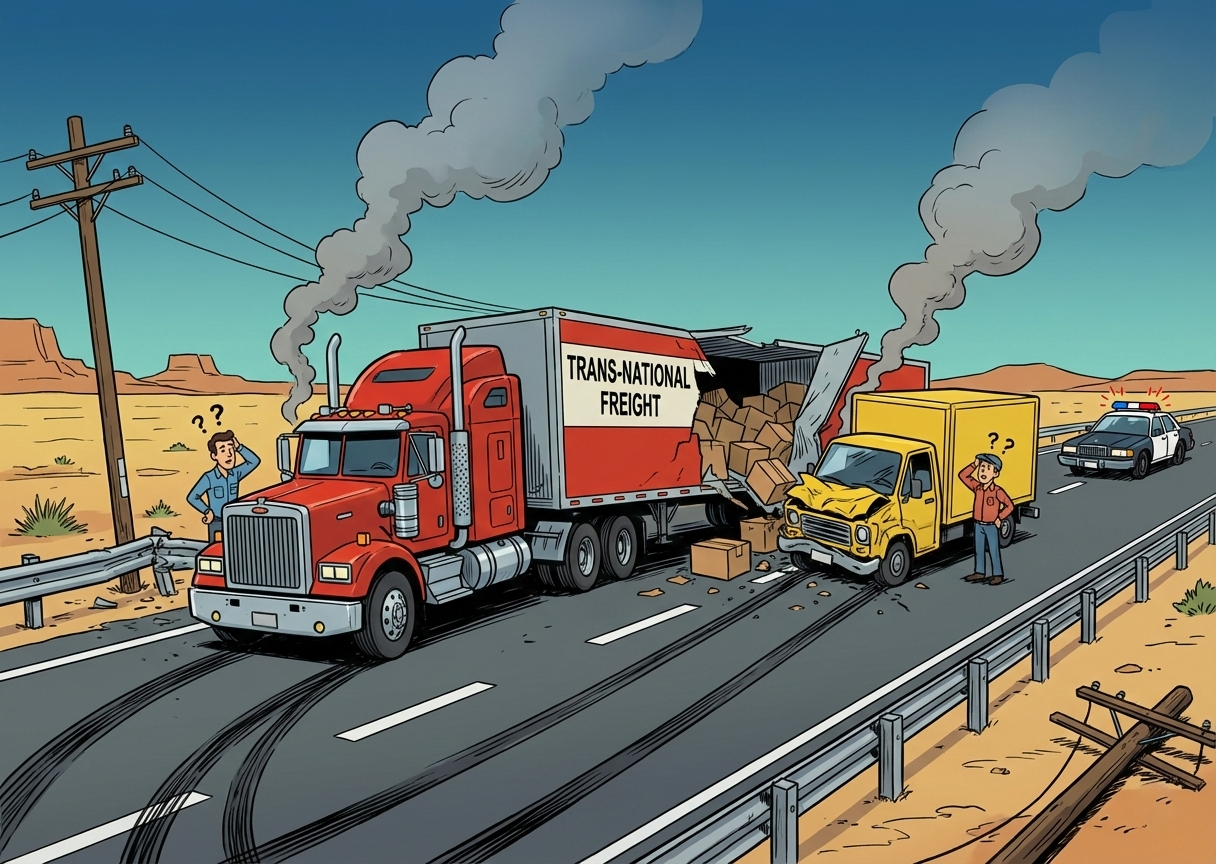
You are driving down the highway, sharing the road with an eighteen-wheeler weighing up to 80,000 pounds. You assume the driver is alert, rested, and trained to handle that kind of power. But inside the cab, the reality may be very different.
Many truck drivers are exhausted. Some have been awake for more than a full day. Others are fighting to keep their eyes open because their delivery schedule leaves no room for rest.
When a fatigued driver drifts, misjudges distance, or slips into a microsleep, the consequences are immediate and catastrophic. Unlike a car, a fully loaded truck needs the length of a football field to stop. A momentary lapse can destroy lives.
Free consultation
Hurt by a drowsy truck driver?
Bennett Legal investigates fatigue cases with forensic precision. Free consultation — no fees unless we win.
If you were injured because a truck driver was too tired to drive safely, this guide explains the real dangers behind fatigue, the rules designed to prevent it, the new technologies emerging to detect it, and the exact evidence your lawyer will use to prove it.
Why Truck Driver Fatigue Is One of the Most Dangerous Problems in Trucking
Fatigue is silent, gradual, and often invisible until it is too late. Research consistently shows that after 20 hours without sleep, a driver's impairment mirrors a blood alcohol concentration of 0.08 — the legal limit. The FMCSA estimates that thirteen percent of large-truck crashes involve fatigued drivers, and many of those crashes occur at full highway speeds with no braking at all.
The pressure on truck drivers is relentless. Delivery deadlines, time-sensitive freight, financial incentives to maximize distance, traffic delays, and mandatory detention at loading docks all eat into the hours a driver has available for rest. This pressure collides with basic human biology. Even the most professional, experienced trucker cannot override the body's need for sleep. When sleep deprivation takes hold, reflexes slow, judgment declines, and attention disappears — often without the driver realizing it.
Five Root Causes of Truck Driver Exhaustion
Fatigue is rarely caused by one thing. It builds through a combination of scheduling pressure, sleep disruption, and industry realities that compound over days and weeks.
Tight delivery schedules and economic pressure are the most common driver of exhaustion. Drivers often feel forced to push the limits because falling behind means losing loads, damaging their standing with dispatch, or losing pay. Some companies create schedules that look compliant on paper but are impossible to complete safely on the road, placing drivers in an impossible position between their livelihood and their safety.
Irregular sleep cycles affect nearly every long-haul driver. Truckers frequently rest during the day and drive through the night, disrupting the circadian rhythms that regulate alertness. Over time, this creates chronic fatigue that a single good night of sleep cannot fix. The body never fully adjusts to a rotating schedule, and the cumulative sleep debt compounds with each shift.
Night driving is inherently riskier even for well-rested drivers because of reduced visibility and lower natural alertness. For a driver already carrying a sleep deficit, the combination of darkness, monotonous highway lines, and a warm cab becomes dangerous. The hours between midnight and six in the morning are when fatigue-related crashes spike.
Long stretches of monotonous highway driving increase the risk of highway hypnosis — a state where the driver zones out, drifts between lanes, or experiences microsleep episodes lasting several seconds. At 65 miles per hour, a four-second microsleep means the truck travels nearly 400 feet with no one in control.
Health issues linked to the trucking lifestyle are widespread and often untreated. Sleep apnea, obesity, poor diet, and limited physical activity are all common in the trucking workforce. Untreated sleep apnea alone is estimated to cause hundreds of fatigue-related crashes each year because the driver never reaches deep, restorative sleep — even when they spend a full ten hours in the sleeper berth.
Warning Signs of Truck Driver Fatigue
Fatigue does not announce itself suddenly. It builds gradually, and recognizing the early warning signs — whether you are a driver or another motorist sharing the road — can be the difference between a close call and a catastrophic crash.
Signs a driver may notice in themselves include frequent yawning or heavy eyelids, difficulty focusing on the road or maintaining a consistent speed, drifting between lanes or hitting rumble strips, missing exits or road signs, irritability and difficulty concentrating, and the inability to remember the last several miles driven. That last sign — the memory gap — is one of the most dangerous, because it means the brain has already begun cycling in and out of microsleep.
Signs other motorists may observe include a truck drifting within its lane or across lane markings, inconsistent speed with unexplained acceleration and deceleration, delayed reactions to traffic changes such as slow braking at red lights or construction zones, and erratic following distance. If you see a truck behaving this way, give it space and consider reporting it. These are not signs of a distracted driver checking a phone — they are signs of a driver losing consciousness.
How Fatigue Impairs a Truck Driver's Ability to Drive
Fatigue affects the brain in the same way as alcohol. A tired truck driver experiences slower reaction times, difficulty judging distance and speed, poor situational awareness, delayed braking, missed traffic signals, and microsleeps lasting anywhere from a fraction of a second to several seconds.
These impairments turn an eighty-thousand-pound vehicle into an uncontrolled threat. Unlike alcohol impairment, which a driver chooses, fatigue can set in without the driver fully recognizing it. A driver who feels "fine" may already be operating at a level of impairment that makes them dangerous to everyone on the road.
FMCSA Hours-of-Service Rules: What You Need to Know
The Federal Motor Carrier Safety Administration sets national limits on how long a truck driver can be behind the wheel. These rules exist specifically to prevent fatigue-related crashes. The core restrictions include an eleven-hour driving limit after ten consecutive hours off duty, a fourteen-hour maximum duty window, a thirty-minute break required after eight hours of driving, and a sixty or seventy hour cap over seven or eight consecutive days.
For a deeper breakdown of how these rules work in practice, including the short-haul exception, sleeper berth provisions, and what happens when a driver violates them, see our detailed guide on truck driver hours of service.
The FMCSA is also reviewing proposed changes for 2026 that may require fatigue-detection systems in new trucks, automated ELD fatigue scoring, mandatory medical screening for sleep apnea, and shorter maximum driving intervals. These proposals reflect rising concern about fatigue-linked crashes and an industry that has resisted meaningful reform for years.
How the US Compares to Canada and Europe
The United States allows longer driving periods and shorter mandatory rest than most developed countries, which is worth understanding when evaluating whether current regulations go far enough.
Canada limits drivers to thirteen hours of driving within a fourteen-hour on-duty window, requires eight consecutive hours off duty, and adds a two-hour flexible rest requirement. Canada also enforces harsher penalties for non-compliance than the US.
The European Union is significantly stricter. EU rules limit daily driving to nine hours (extendable to ten twice per week), require a forty-five-minute break after four and a half hours, mandate eleven hours of daily rest, and enforce a weekly rest period of at least forty-five hours. By comparison, American drivers can legally drive longer on less rest — a regulatory gap that the data on fatigue-related crashes reflects.
New Technology Designed to Prevent Fatigue
Modern trucks are rapidly adopting technologies designed to detect or prevent fatigue, and any of these systems can become crucial evidence in a crash case.
In-cab cameras with AI fatigue detection analyze blinking patterns, head position, yawning frequency, and steering behavior in real time. When the system detects fatigue, it triggers an alert to the driver and notifies fleet managers. These systems generate logs that your attorney can subpoena.
Biometric wearables such as smartwatches and sleep monitors are now required by some carriers. They track sleep quality, duration, and heart rate variability to identify drivers who are at risk before they get behind the wheel.
Steering-input sensors track micro-corrections and drifting patterns to calculate an alertness score. Sudden increases in corrections often indicate a driver fighting to stay awake.
Lane-departure and forward-collision alerts are critical last-line safeguards when fatigue causes drifting or delayed braking. If these systems activated before a crash, the data records become powerful evidence that the driver was impaired.
Predictive fatigue analytics built into modern ELDs now offer fatigue risk scores based on sleep patterns, duty cycles, and prior shifts. If a carrier's own system flagged a driver as high-risk and the driver was dispatched anyway, the company's liability increases substantially.
How Fatigue Causes Catastrophic Truck Accidents
Fatigue-related crashes tend to be among the most severe because the driver often fails to brake at all. The truck drifts into oncoming traffic or off the road at full highway speed, the driver reacts too late to stopped traffic or construction zones, and the sheer weight of the vehicle — up to 80,000 pounds — turns every impact into a high-energy collision.
These crashes frequently result in traumatic brain injuries, spinal cord damage, multiple fractures, and fatalities. The severity is compounded by the fact that fatigue crashes disproportionately happen on high-speed highways during overnight hours, when other drivers are also less prepared for an unexpected hazard.
How to Prevent Truck Driver Fatigue: Strategies That Work
While this post focuses on what happens when fatigue causes a crash, prevention matters too — both for drivers reading this and for understanding what a trucking company should have been doing.
Strategic napping is one of the most effective countermeasures. A twenty-minute nap before a long drive, or during a break, can restore alertness more effectively than caffeine. The key is timing — napping too long triggers sleep inertia and makes grogginess worse.
Caffeine, used correctly, helps in the short term but is not a substitute for sleep. It takes about thirty minutes to take effect, which is why pairing a cup of coffee with a short nap (the "coffee nap") is a well-studied fatigue countermeasure. However, caffeine masks fatigue rather than eliminating it, and relying on it across multiple shifts creates diminishing returns.
Recognizing personal fatigue triggers is something experienced drivers learn over time: which routes are worst, which shift patterns lead to exhaustion, which loading dock delays destroy their rest window. Companies that support drivers in managing these triggers — by adjusting schedules, allowing flexible rest, and not penalizing drivers who stop when they are tired — have fewer fatigue-related incidents.
Medical screening for sleep apnea should be standard practice. Drivers with untreated sleep apnea may comply with every HOS rule and still be dangerously fatigued because they never achieve restorative sleep. A company that fails to screen for or accommodate sleep disorders is creating risk it could have prevented.
Proving Truck Driver Fatigue: The Evidence Your Lawyer Will Use
You do not always need to prove fatigue to win a truck accident case — you only need to show the driver acted unreasonably. But proving fatigue strengthens your case, increases settlement value, supports punitive damages, and broadens company liability.
The evidence specific to fatigue cases includes hours-of-service logs and electronic logging device data showing whether the driver exceeded legal limits or drove during vulnerable hours, in-cab fatigue-monitoring data from AI camera systems or steering sensors, cell phone records showing late-night screen activity during rest periods, receipts and transaction records proving the driver was awake instead of sleeping, medical records indicating untreated sleep apnea or other sleep disorders, company scheduling records revealing unrealistic dispatch timelines, and stimulant or drug testing patterns that suggest a driver was using substances to stay awake.
For the full range of evidence used in truck accident litigation beyond fatigue — including maintenance records, cargo documents, black box data, and accident reconstruction — see our guide on critical evidence in commercial truck accident lawsuits.
Fatigue often reveals itself in the details. A receipt from a truck stop at 3 AM during a supposed rest period, a pattern of ELD edits, or a company dispatch log showing a driver was assigned back-to-back loads with no realistic rest window — these are the kinds of evidence that transform a case.
The Economic Cost of Fatigue-Related Truck Crashes
Fatigue-related crashes cost the US economy an estimated thirteen billion dollars per year. That figure includes medical costs, lost productivity, emergency response, property damage, litigation, and insurance losses. It does not capture the full human toll — the permanent disabilities, the families destroyed, and the long-term care that victims require for years after the crash.
These numbers reflect a systemic problem. Fatigue is not an accident — it is the predictable result of an industry that has historically prioritized delivery speed over driver rest.
What to Do After a Fatigue-Related Truck Accident
If you suspect fatigue played a role in your crash, the steps you take immediately afterward are critical — and some are specific to fatigue cases.
Get medical attention first, even if you feel fine. Adrenaline masks injuries, and documentation of your condition from the day of the crash is essential for your case.
Note the time of the crash. Fatigue crashes cluster between midnight and 6 AM and in the mid-afternoon. The time of your crash relative to the driver's likely duty cycle is a key piece of evidence.
Request that evidence be preserved immediately. ELD data, in-cab camera footage, and fatigue-monitoring logs can be overwritten or altered if you wait. Your attorney can send a spoliation letter to the trucking company requiring them to preserve all electronic data.
Do not speak with the trucking company's insurance adjuster before consulting an attorney. Fatigue cases involve more complexity than a standard car accident, and adjusters are trained to minimize what they pay. For more on protecting your claim in the critical first days, see our guide on what to do after a truck accident.
Do not post about the crash on social media. Defense attorneys will search your accounts for anything they can use to undermine your case.
Contact a truck accident attorney right away. Fatigue cases require early action because logs can be altered and evidence disappears quickly. The sooner your lawyer sends preservation demands, the stronger your case will be.
How Bennett Legal Proves Fatigue and Builds Your Case
At Bennett Legal, we approach fatigue cases with the forensic precision required to take on major trucking companies and their insurers.
We secure ELD logs and black box data before companies can alter them, often within hours of being retained. We review dispatch records line by line for scheduling pressure that made fatigue inevitable. We analyze hours-of-service compliance in detail, looking not just for violations but for patterns — drivers who consistently log exactly the maximum allowed hours, suspicious edit histories, and gaps between ELD data and fuel receipts.
We investigate background issues such as untreated sleep apnea and whether the company screened for it. We subpoena driver-monitoring systems and telematics data. We reconstruct the crash with forensic specialists who can show exactly what happened in the seconds before impact. And we identify every regulatory violation that triggers negligence per se under Texas law.
Many fatigue cases involve more than just the driver. Companies may face liability for encouraging drivers to exceed hours, failing to screen for sleep-related disorders, ignoring prior fatigue violations, setting impossible delivery schedules, and overworking new or inexperienced drivers. Holding the company accountable — not just the individual driver — often increases both compensation and accountability. For more on how trucking company liability works, see our guide on commercial truck accident liability.
When Fatigue Leads to Serious Injury, We Fight for You
A truck driver who operates while exhausted puts everyone around them at risk. When that decision leads to a crash, you should not be left carrying the cost.
We prepare fatigue cases with the same level of detail used in major litigation — investigating the driver, the company, the logs, the technology, the policies, and the pressure behind the scenes. Our goal is to secure compensation for medical bills, lost income, future treatment, pain, permanent disability, and punitive damages when the conduct warrants it.
You deserve answers, accountability, and compensation that reflects the full impact of what happened. If you or a loved one was injured because a truck driver was too tired to drive safely, contact Bennett Legal for a free consultation. We are ready to help.
Free consultation
Hurt by a drowsy truck driver?
Bennett Legal investigates fatigue cases with forensic precision. Free consultation — no fees unless we win.